Friday, February 13, 2009

Friends of fat cats? Suddenly, 3 Dem pols look like they may be protecting rich from taxes

Juan Gonzalez

Juan Gonzalez [News]
Friday, February 13th 2009, 4:48 AM

Why won't Majority Leader Malcolm Smith and two top Senate Democrats ask New York's landlords and wealthiest residents to share the pain of these tough times with the rest of us?

Smith and Bronx Sens. Pedro Espada Jr. and Jeff Klein have suddenly emerged as key obstacles to two of the most important reforms the Legislature's Democratic majority wants to achieve this year.

The first measure would rewrite state rent laws and keep nearly a million rent-stabilized apartments - most of them located within the five boroughs - affordable to working and middle-class families.

It would do this by eliminating vacancy decontrol, which former Gov. George Pataki and the Republicans instituted back in 1997.

Early this month, Assembly Democrats overwhelmingly approved several versions of rent reform. One of those versions would eliminate the $2,000 threshold for vacancy decontrol and reestablish tenant protections for apartments with a monthly rent of up to $5,000.

The other piece of legislation, the Fair Share Tax Reform Act, has been rapidly gaining support. Better known as the "millionaires tax," it would generate $6 billion to help plug a record deficit in the state budget. In its latest form, the proposal would raise tax rates for households making over $250,000 in taxable income.

Landlords and other powerful interest groups are gearing up for a titantic battle in Albany.

Several private-equity firms are worried about rent reform. They spent billions in recent years gobbling up rent-stabilized apartment buildings - even in the city's worst neighborhoods.

Prices for real estate skyrocketed as speculators promised huge windfalls once they got rid of old tenants and jacked up rents.

Many of those plans are in shambles, and investors in highly leveraged buildings fear rent reform will make things worse.

Enter Smith, who represents a solid middle-class area of southeast Queens. Until last year, he backed more tenant protection.

But the new Smith is talking more like a Republican. He has refused to back either the reform proposals or the millionaires tax. Same for Klein, the deputy majority leader, and Espada, head of the Senate's powerful Housing Committee.

"If you raise taxes, the potential is that someone who has the income of a million or more will have the ability to be mobile [and leave the city]," Smith said.

"We cannot simply raise taxes on the wealthy to fill a budget gap, without putting money back in the pockets of middle-class people," Klein said.

"I'm a little hesitant about the millionaires tax," Espada said. He said he favors "some kind of a hybrid progressive income tax," but would not give specifics.

What Smith, Klein and Espada won't acknowledge is the tiny percentage of households in the city that earn $1 million a year, or even $250,000, after taxes.

State records show a mere 393 households in Smith's Queens senatorial district reported incomes above $250,000 in 2005. More than 93,000, or 99.6%, were below that figure.

Virtually the same is true of Pedro Espada's west Bronx district. Some 81,000 households had incomes below $250,000, and only 391 above that.

Even in Sen. Liz Krueger's district on the upper East Side, the richest in the city, only 15% of taxpayers (22,000 households) reported incomes over $250,000.

New York once boasted a "progressive" income tax system, said Sen. Eric Schneiderman, a prime sponsor of the Fair Share proposal. The more a person earned, the higher the percentage he or she paid in taxes.

TODAY, A person earning $40,000 a year is in the same top tax bracket of 6.85% as someone making $40 million. Schneiderman wants higher brackets. He wants to start at 8.25% for those over $250,000, and higher for those over $1million.

The answer to this crisis, Schneiderman and other Democrats say, is getting the few at the top who benefited in the boom years to share the pain of the bust years with the rest of us.

The new majority leader needs to get with his majority.

jgonzalez@nydailynews.com

Thursday, February 12, 2009

The Real Campaign is to Suppress Challengers


By Gary Tilzer

The Real Campaign is to Suppress Challengers

Using the Courts and the CFB Rules to Win Elections

Every year in an annual ritual, scores of candidates, many running for the first time are denied a chance to compete in the electoral process or have their campaign efforts severely harmed by the obstacles of ballot access. New York’s election law is among the most stringent in the nation. It poisons the democratic process and is kept in place by incumbents and a political machine which gain advantage by those that it harms. Sometimes more than half of a challenger’s time and resources (for those that make it through the petitioning process), are used up to get through the obstacles put in place to deny them ballot access. Many races are decided in the courts or by Campaign Finance Board (CFB) rules, not the ballot box. It not just the petitions system that machine-backed candidates use to block ballot access, the CFB rule which allows a candidate who challenges his opponent(s) petitions to receive matching funds, but not the candidate(s) he is challenging, has become a weapon to gravely weaken ones challenge(s).

A great example how the insiders used the CFB rules to their advantage is the special election to fill the council seat of Congressman McMann. Kenneth Mitchell a machine backed candidate in this month's special election to fill a Staten Island council seat challenged almost all of the other candidates in the race. As of Tuesday morning the strongest challenger to Mitchell, John Tabacco was still tied up at the Board of Elections with the special election less than two weeks away. He was put on the ballot that afternoon but has lost valuable campaign time. The Mitchell campaign, war chest full of the city’s matching funds, has been doing mailings and hiring workers to GOTV all along. The Tabacco campaign was stalled by Mitchell's creative use of the CFB rules and now has to dump mailings made possible by the matching funds just becoming available on a public that has already tired of having their mailboxes full of promises to spend more money the city does not have.

Only the Rich and Insiders Can Beat Tammany’s Rule
Tammany Hall designed the petition scheme which is at the heart of New York’s arcane and complex ballot system, to keep machine candidates in office. The Board of Elections (BOE) also designed by Tammany, reviews petitions and rules candidate on and off the ballot, and consists of the appointees of the democratic and republican political machines. Despite generations of poor management and efforts by several mayors and newspaper editorial boards to reform it, the board continues its Tammany Hall Mission as a Gatekeeper to ballot access, knocking off challengers.

Those who support the petitions system say it prevents candidates without community support from running. What it really does is prevent challengers who cannot afford to pay for petitions, a good election lawyer and court costs - from running for office. Challengers must also have an insider on their campaign team to make it past the petitioning process. To win at the BOE you must bring a court procedure challenging the ruling of the board even before the Board has ruled. Unschooled insurgents chasing after the democratic dream of free and open elections fail to grasp the element of this logic. The machine and incumbents even use government to pay for their candidate’s petitioning by giving out election inspector jobs in exchange for collecting petitions for their candidates. It is a system that Boss Tweed is proud of to this day. It has also robbed us of our democracy and the protections the Founding Fathers designed for us.

Millions of New York’s voters are denied by Tammany’s petition racket, the chance to choose among the best of the potential candidates, who can solve their city’s critical problems. What this system leaves us with is a gang of insiders who have mastered the election process or have family or political connections to the machine and the City’s establishment.

Most incumbents have no challengers in the primary which are the real elections in NYC. Only one incumbent councilmember was defeated in both the 2003 and 2005 elections. More than half of the polling stations in NYC were closed in the last election. In Manhattan in 2008 only two of the eleven Assembly incumbents were challenged, none of the state senate or congressional candidates had an opponent in the primary. Brooklyn has 49 elected officials – 16 councilmembers, 8 State Senators, 19 Assemblymen and 6 Congress members. Only one, Senator Martin Golden, is a Republican. And that one will be gone in 2012 when his gerrymandered district is redrawn by a Democratic majority redistricting team.

Lack of competitive elections has also denied the City real debates on the issues that affect and hurt its residents. The press and campaign issues in the Incumbent Protection Society tend toward political spin designed to empower those already in power. Freedom of the ballot lies at the root of the American Political System. The Founding Fathers believed that decent opposition would not only be necessary to represent the voters, but would also reduce corruption and inefficiencies in government by getting the public educated and behind the true fixes to their problems. According to the intent of the framework of our democracy, today’s Incumbency Protection System has blocked opposition candidates who could have developed public awareness of potential government policies that might help keep the middle class in the City, build the City’s tax base beyond Wall Street and fix our city's schools.

The press and good government groups have been MIA on ballot access. Good Government groups have ignored ballot reform in favor of regulation of campaign financial practices, and the press has been going after the Board of Elections on its management screw-ups, not how it destroys the campaigns of challengers. By corrupting the CFB which was created to increase political competition, with payout delaying tactics, the machine and IPS has shown the newspaper editorial boards and good government groups that they must fight for increased political competition in New York City’s elections, not quick fixes. The Incumbent Protection Society has destroyed democracy in New York and created dysfunctional government in its destructive path, while enriching itself and its friends. Even the rich and established are its victims. Will those who can fix the system be able to fix the city? ….Will they wake up or learn how to? … The Future of New York City depends on it.

The Accidental Ballot Access Reforms
The only reform in ballot access in the last 20 years occurred because the Bush campaign tried to keep John McCain off the New York Primary Ballot in 2000. A Federal Judge ruled after the McCain campaign took the Republican Party to court, to eliminate the need for ADs, EDs and totals on nominating petitions cover sheets. Judge Edward Korman who also ruled that candidates can correct their petitions cover sheets for defects after they are submitted to the Board of Elections, did more then any Good Government group to make a very restrictive ballot access system a little bit easier for challengers.

FIRE DOWN UNDER


AUSTRALIAN HEAT WAVE AND DEADLY FIRES

By Eric K. Williams(

Special to YOUR FREE PRESS)Melbourne, Australia -


The death toll stands at 181 but, police in Victoria are expecting that number to rise significantly upwards, with scores of people still unaccounted for and, among the missing. What's more, while many of the fires were started because of the hot and dry conditions, there is the assumption on the part of police and, the Prime Minister, Kevin Ruud, that a number of the fires were set deliberately. There is video tape evidence to back this up. Two suspects are in custody as investigations continue. 30 fires are STILL burning around Victoria as of this writing. No rain in the forecast.

The current heat wave has subsided at the moment but, is expected to return early next week. Forecasts call for more 40-plus degree Celsius temperatures starting on Monday. Last Saturday, the temperature hit 48.7 degrees Celsius in much of Victoria. It was 46 in Melbourne city, proper. The highest temps EVER recorded in this state. Translated that is about 120 degrees Fahrenheit in U.S. measurements. What is odd is that while Victoria burns, there is heavy rain and flooding in the Australian state of Queensland to the north. Streets are flooded and, rescue teams are present there now.

This follows mass flooding in the Pacific Island nation of Fiji, north and east of Australia, from mid-January. There are brush fires underway now in New Zealand but, not on the scale of what has taken place in Australia. On Friday, the 13th of February, (Thursday in the U.S. and Europe,) there will be a national day of mourning called by the Prime Minister, Kevin Ruud. Large gatherings are expected at St. Paul's Cathedral in Melbourne, where I will be this morning. Similar events are scheduled in most of the rest of the country. Nearly everyone I have spoken to and, know here in Melbourne, has been touched by this spate of heat and, brush fires. That is, they either have a friend or relative who has been touched by this event, or know someone who has.

One friend, whose elderly 80 plus year old father was in a nursing home just north of Melbourne, died last Saturday. Much of the U.S. media has not paid close attention to this story and, regard it as being 'too far away' from the Americas for U.S. audiences to care. In truth, the story warrants wide and detailed coverage because, this is the clearest case yet of Global Warming, having a major impact on a fellow industrialized nation. This could happen in the United States and, besides, there are American ex-patriots I know personally, who were directly touched by this phenomena.

What makes this scary is that even the occasional high winds offer no relief. The air, blowing down from northern Australia, is as hot as a furnace and, further dries already dry conditions. Complicating matters even further is the drought. Victorian government officials, for example, had been airing 'save water' public service announcements on local television stations in recent weeks. In Melbourne less than three weeks ago, a water main broke in the Northcote district of this city, as millions of gallons of water shot over 20 meters high into the air and, spewed down sewers and was lost. Politically there is a debate among federal lawmakers in Canberra, the national capital, over the stimulus package and, spending on infrastructure.

The measure, advanced and supported by the Labor party led government, was defeated days after the height of the heat wave and brush fire emergency. This story is changing by the hour as I write this but, the Summer season is at mid-point. That means, the very likelihood of this current emergency repeating itself is not only possible but, scientists believe, probable.

Wednesday, February 11, 2009

Fox News Channel Producer Busted for Porn


Tuesday, Feb 10
FNC Producer Aaron Bruns Arrested
A TVNewser tipster tells us Aaron Bruns, a producer in the Fox News Channel Washington, D.C. bureau, has been arrested and charged with one count of possession of child pornography. A Fox News spokesperson confirms, telling TVNewser, "We are aware of the arrest and he is currently suspended without pay."
Bruns is in federal court in Washington, D.C. this afternoon appearing on the felony charge.
Bruns has been with FNC for more than six years. He was an embed producer with the Hillary Clinton campaign last year.
Developing...
> Update: FishbowlDC reports this is not Bruns' first run-in with the law. He dropped out of the University of Michigan in 1999 after being arrested on charges of distributing child pornography. So why wasn't Bruns checked out by Fox News? A network spokesperson tells TVNewser criminal background checks were not instituted until 2003. Bruns was hired in 2002.
> Update (2): The Smoking Gun has obtained the arrest affidavit. A warning that it is graphic in its detail.

Tuesday, February 10, 2009

Stressful Times


As the economy continues to deteriorate, stress levels are on the rise. That means more hospital visits and doctor appointments also. Here are a few tips:

Record all necessary information
Keep a short medical history tucked into your wallet or purse, says Dr. Virgie Bright-Ellington, M.D., Internal Medicine and author of What Your Doctor Wants You to Know But Doesn't have Time to Tell You (Hilton Publishing, 2009). It should include your allergies, a complete list of your medications and dosages as well as any over-the-counter supplements and vitamins you're taking. Keeping it in your wallet or purse will make your list easily accessible (and easy to maintain and update) when you need it.

Do a quick double-check before you head out: do you have your health care numbers and information with you?3. Make the most of the visitBe on time for your appointment. While it's true your appointment might be delayed because of unanticipated emergencies your doctor runs into during the course of her appointment day, don't start the appointment off on the wrong foot by showing up late. If you're scheduled for a 15-minute appointment and you're five minutes late, the doctor will be pressed to catch up.

If you think you might have paperwork or forms to fill out, show up early and get the paperwork done before the start time of your scheduled appointment.Unforeseen emergencies are the mainstay of a doctor's life. If your appointment is unavoidably delayed, make the most of the wait time by bringing something along to work on while you wait.

Crossword puzzles, a good book or a little project from the office will make the wait time pass quickly and efficiently.Take notes -- your doctor knows you won't remember everything she says, especially if you're in uncharted medical territory. Jotting down key points during the course of the appointment will help you recall the details later and help set you up for follow-up appointments.

Notes taken during the appointment should include any prescription details and medical advice related to your doctor's diagnosis. If a follow-up visit seems indicated, make note of anything the doctor will want you to bring or to talk about at the next visit. Medical appointments can be stressful. If you're worried about how well you're going to absorb and retain the information your doctor gives you, think about having an advocate -- a spouse, a sibling, or a friend -- go into the appointment with you.

Sunday, February 8, 2009

Saturday, February 7, 2009

FDA: Ga. Plant Knowingly Sent Tainted Goods

Raw Peanuts - $1.12/lb

Peanut Corp. Of America Denies Any Wrongdoing

Friday, February 6, 2009 – updated: 5:02 pm EST February 6, 2009

Federal health officials said the Georgia peanut plant at the center of the salmonella outbreak knowingly shipped tainted products.
Salmonella Q&A | Reduce Risk
Previously, the Food and Drug Administration had said Peanut Corp. of America retested products after getting an initial positive result for salmonella. The agency said the company shipped the goods after follow-up tests came back negative. But Friday, the FDA said the company sent out peanut butter, chopped peanuts and peanut meal that had tested positive even before it got back any negative findings. Peanut Corp. denies any wrongdoing. The government has opened a criminal investigation.Federal inspectors found that the peanut plant exposed some of its equipment to insecticides in 2001. In a report based on that visit nearly eight years ago, inspectors said that workers at the Peanut Corp. of America's plant used an insecticide fogger not suitable for food areas and didn't wash its equipment. Food and Drug Administration inspectors also found dirty duct tape on broken equipment, dead insects around peanuts, and gaps in doors that allowed rodents to enter the plant. Those findings in 2001 are similar to problems discovered last month after the company shipped salmonella-tainted peanuts and peanut butter linked to at least eight deaths and 575 illnesses in 43 states. On Friday, the Department of Agriculture said the federal government sent potentially contaminated peanut products to schools in three states for a free lunch program in 2007. Officials said peanut butter and roasted peanuts processed by the Peanut Corp. of America were sent to schools in California, Minnesota and Idaho.More than 1,300 foods that used ingredients from the company's processing plant in Blakely, Ga., have been recalled.While the outbreak appears to be slowing down, new illnesses are still being reported.Also on Friday, the Federal Emergency Management Agency said it is going to ship 660,000 new meals to storm-damaged Arkansas and Kentucky after finding some of the packages contained recalled peanut butter. The news came a day after the agency identified meals distributed in Kentucky had packets of peanut butter recalled in the nationwide salmonella outbreak. The meals had not yet been distributed in Arkansas. FEMA said it has not received any complaints about illnesses from the peanut butter. FEMA said it is shipping Meals Ready to Eat, designed for use by the military, to the two states to replace the commercial meal kits previously sent.

POOR KIDS GET TAINTED FOOD

updated 5:01 a.m. ET, Fri., Feb. 6, 2009

WASHINGTON - Peanut Corporation of America sold 32 truckloads of roasted peanuts and peanut butter to the federal government for a free-lunch program for poor children even as the company's internal tests showed that its products were contaminated with salmonella bacteria.

Yesterday, the U.S. Department of Agriculture abruptly suspended its contract with the company, which is at the center of an outbreak of salmonella illness that has killed eight people, sickened 575 and triggered one of the largest food recalls in U.S. history.

The fact that a federal agency that shares responsibility for keeping food safe was among the thousands of customers that may have received tainted food from the Blakely, Ga., plant is the latest revelation in a scandal that has exposed an array of failures in the government's systems for keeping deadly pathogens out of the food supply.

Wildlife Conservation Society Issues Statement On Proposed State Budget Cuts

Monkey seated in tree
December 23, 2008 – The following statement was issued by the Wildlife Conservation Society Executive Vice President for Public Affairs John Calvelli:

"Governor Paterson’s proposed state budget cuts this year and the complete elimination of state funding in fiscal year 2010 for zoos, botanical gardens and aquariums mean the Bronx Zoo and New York Aquarium face devastating cuts. The governor’s proposal is disproportionate and severe.

This year alone, living museums, like the Bronx Zoo and New York Aquarium, are singled out for the largest reduction -- 55 percent -- very disproportionate to others -- for no strategic reason. Next year, 76 zoos, botanical gardens and aquariums are zeroed out of the budget. This proposal from the governor comes as our nation experiences an economic crisis, which means the Bronx Zoo and New York Aquarium are facing further financial challenges by funding cuts from the city. It is clear: We can't fire our bears or furlough our sea lions. All options are on the table, including cutting staff and services.

For more than 113 years, we have offered an education experience and access to wildlife from around the world to millions of New Yorkers and tourists. We generate significant dollars each year for the state in tourism and economic development. The funding for Zoos, Botanical Gardens and Aquariums (ZBGA), a 25-year-old funding program, within the Environmental Protection Fund (EPF), has helped to educate the current and next generation of environmental stewards. These institutions are the economic drivers that spark jobs and a tremendous amount of stimulus to our state’s economy with 10 million visitors annually. The Wildlife Conservation Society’s Bronx Zoo and New York Aquarium, alone, generated more than $289.6 million in economic activity in FY 2008.

According to a 2008 national public opinion survey, 79 percent of Americans believe that zoos and aquariums are good for their local economy, and an impressive 80 percent believe that zoos and aquariums are important enough to local communities to be supported by government funding.

We know we need to be a part of a budget solution and that is all we are asking. Don't cut with an ax, but with a strategic scalpel. All of us need to contact our state officials ASAP. We need to have a united voice: Please don't unfairly cut the Bronx Zoo and New York Aquarium. Go to www.wcs.org to take action and save the zoo and aquarium."

The Wildlife Conservation Society saves wildlife and wild places worldwide. We do so through science, global conservation, education and the management of the world's largest system of urban wildlife parks, led by the flagship Bronx Zoo. Together these activities change attitudes towards nature and help people imagine wildlife and humans living in harmony. WCS is committed to this mission because it is essential to the integrity of life on Earth.

Click and See Video

WCS Video

Friday, February 6, 2009

GABE PRESSMAN'S VIEW


The U.S. Senate will decide in the next few days whether to pass a law safeguarding the right of journalists to protect their sources.

Arlen Specter, the ranking Republican member of the Senate Judiciary Committee, argues passionately for the enactment of this legislation: Far more than the protection of journalists is involved here, the senator says. It’s “protection for the public and for our form of government.“

The Senate majority leader, Democrat Harry Reid, wants a floor vote on the legislation before the August recess. The bill establishes a federal privilege for reporters to “protect and encourage the free flow of information between journalists and confidential sources.” The new law would balance the public’s right to know with the needs of law enforcement and the duty of judges to ensure that trials are fair.

Why should people care about this proposed law? Because it goes to the very core of our democratic system of checks and balances. One of the most important checks is the press itself. With disturbing frequency prosecutors have, in recent years, called reporters before grand juries, trying to pry out of them the names of the people who gave them information. Several reporters have been jailed for refusing to identify sources that had been promised protection in return for information.

The issue of protecting journalists has a particular resonance in New York City. For it was here that, in an epic case, the cause of freedom of the press won a great victory.

Back in the hot summer of 1735, a half-literate printer named John Peter Zenger was slapped into jail here for having the temerity to criticize the English governor of New York in an article in his New York Journal. The Journal was the equivalent of an 18th century blog. Zenger criticized the governor and, by implication, the crown, for various reasons. He was accused of sedition and libel, but a brilliant lawyer named Andrew Hamilton argued that truth was an absolute defense, and that Zenger had written truth.

Hamilton declared that that this was not the cause of just a poor printer or of New York alone, adding: “It is the best cause. It is the cause of liberty.” The jury brought back a quick verdict, not guilty. Zenger was freed and a crowd of spectators cheered.

Nearly 300 years later, an old battle seems to be renewed. Again, voices of authority have put pressure on journalists. Again, in what appears to be an effort to suppress the truth or at least intimidate truth seekers, some government authorities have put the muscle on reporters. The Senate should reaffirm a basic American value before it adjourns by passing the shield law.

2009 NYP Placards Delayed as Legal Issues Mulled


A source close to the situation tells the Press Club that this year's delay in the distribution of NYP Parking Placards is likely the result of an internal investigation by NYPD lawyers into various legal aspects of the department's role and procedures in issuing the cards.

The placards are used by reporters, photographers and news crews as a way of identifying "on assignment" press vehicles to traffic enforcement agents.

Distribution delays at the beginning of each year are not uncommon though this year the placards are especially late, judging from the number of "what's going on?" inquiries received from concerned Press Club members.

The well-placed source tells the Club that the cause this time is most likely an internal study that is an offshoot of the recent NYPD decision to issue Press Identification Cards to three individuals whose initial requests for the credential had been denied.

In a lawsuit filed late last year, the three men charged that the NYPD process for allocating press credentials is inconsistent and unconstitutional, claiming it permits the department to arbitrarily deny press cards to journalists whose viewpoints are controversial, unpopular or in some way disagreeable to the NYPD.

Among other remedies, the suit demanded that NYPD be required to publically explain its criteria and its processes for deciding who is credentialed and who is not. The department relented on the main demand in January and issued Press ID cards to the trio.

Even after that victory, the lawyer for the three men, Norman Siegel, said he would continue fighting what he characterized as NYPD's unconstitutional credentialing process.

While not directly related to the press ID card case, says our source, the placard delay has likely been ordered while the department studies its positions and options as an issuer of any kind of press credential.


Bloombito and His Protesters


See article bellow
February 3, 2009

The $20 dollar man vs the $20 billion dollar man

Rafael.jpg
Rafael Martinez-Alequin, the feisty journalist who seemed to have gotten under Mayor Bloomberg's skin for his incessant (and annoying) questions about issues that he says affect the poor and working class folk of this City, is back at City Hall. His shiny new 2009 NYPD press credential hanging around his neck. The reporter and editor of New York City Free Press made a federal case out of the fact that his credentials were not renewed or as he says, "unfairly revoked," in 2007 by the agency that doles them out, the NYPD.

"I'm glad to have the credentials back," gushes the Puerto Rico-born scribe, "but the case is still going forward, it's now in Federal Court." According to Martinez-Alequin, the lawsuit asks the fundamental question: why is the NYPD the ones who determine who is a journalist or not?

But just because the 75-year old journalist for yourfreepress is back in the Blue Room, the corner room in City Hall where the Mayor holds news conferences, doesn't mean that Bloomberg will talk to him.

"I raise my hand, but he (Bloomberg) won't take my questions," says Martinez-Alequin. "I won't shout out the question because I have respect for the Office of the Mayor, not necessarily its current occupant." Besides," he asks, "what's a $20 billion dollar man afraid of a $20 dollar man?"

Two other bloggers, Ralph E. Smith, a reporter and publisher for GuardianChronicle.com and David Wallis, editor of Featurewell.com also got their credentials renewed. Norman Siegel is the attorney on the case.

Martinez-Alequin, who is going to turn 76 in the last day of March, is unstoppable in his quest he says to get answers for the little people of this City.

"Many of the denizens of the press are beholden to the Mayor and their editors," he says. "They are afraid to ask questions that might get the Mayor angry.Then they won't get scoops."

Asked what question he'd d ask Mayor Bloomberg if he's called on, Martinez-Alequin offers dryly: "why is he always on the side of the rich, powerful and the corporations and not on the side if the poor and working class?"

Wednesday, February 4, 2009

Tuesday, February 3, 2009

Appointments Strengthen Special Interests, Corrupt Politicians

by Gary Tilzer

Appointments Strengthen

Special Interests
Lobbyists
Corrupt Politicians $$$


Senator Russ Feingold has proposed a constitutional amendment which would require that vacant Senate seats be filled by popular election. The senator says he wants to replace high-level deal-making and arbitrary exercises of authority with democracy.

While the recent election brought change to the nation, New York has been headed in the opposite direction with several high level appointments and power plays during a change in party leadership of the state senate. All of the New York changes have strengthened the “Political Industrial Complex" – the insiders. This is clearly demonstrated by following Senator Gillibrand in her attempt to solve her issues problems and gain political power. She started off with high-powered lobbyist and former Republican Senator Al DAmato at her announcement. Also there was former mayoral candidate now working as a lobbyist for Mercury Public Affairs, Freddie Ferrer. Gillibrand hired lobbyist Roberto Ramirez, of Mirram Group, as a consultant to help with her Latino problem. Besides hiring lobbyists she has been meeting and calling elected officials all over the state.

A winning candidate in an election has had meetings with voters and made promises for change in order to win their support. Because of the power and publicity inherent in incumbency, appointed officials see an effective strategy to win in making peace with the insiders who run government. The recent epidemic of appointments has strengthened the power of state insiders. Andrew Stengel was hired away from the Brennan Center by the senate democrats as a senior policy adviser for government reform. Stengel, who recently called Albany's efforts to reform "cosmetic fixes", has seen the job become much harder with New York's appointed government. Stengel has to look no further then Carl Kruger a senator in the chamber he works for. Kruger was called the leader of the “Gang of 4 or 3” which held up majority leader Smith, gaining control of the senate for two months. Kruger ended up voting with Smith after his gang was paid off in chairmanships, and in a letter just sent, thanked Brooklyn County leader Vito Lopez and Bronx County leader Carl Heastie for their invaluable help in bringing negotiations to a conclusion.

After running the gang in an open rebellion that negotiated with the Republican leadership, Kruger in his letter said he was proud that the Democrats controlled the senate for the first time in 43 years. He also said that the Democratic senate will move New York towards reform and a more open government. In 2007 when Kruger became the only Democrat named as chairman by Bruno, “He emphasized the need to set aside politics and partisanship for the sake of the public interest, ethics and good governance.” Kruger the proud Democrat, set aside politics often. He endorsed Republicans Pataki, Giuliani and then Lazio against Senator Hillary Clinton.

Kruger, even released a statement in support of Bruno after the majority leader revealed late last year that his outside business interests are the subject of an FBI probe. Kruger said questions about Bruno's integrity were "appalling and ironic", given his commitment to "openness and fairness".

Kruger on Ethics
A 2001 endorsement of Ferrer came after Kruger attended a controversial strategy session with the Mark Green campaign at Nick’s Lobster House in Sheepshead Bay. Though Kruger denies this, numerous sources have told us that it was Kruger who animatedly advised Green’s people to tie Ferrer to Al Sharpton in order to hurt Ferrer with white voters. – Feb. 14, 2005, Brooklyn Politics

"Today a Politicker 'blog' repeated the lie that I was involved in the 'racist' Green campaign flyer. These are the facts. I attended a lunch of Mark Green supporters and campaign staff where the idea of such a flyer surfaced. I told them in the strongest terms that it was wrong. After leaving the lunch I contacted Fernando Ferrer. I then notified the Green campaign that I could not support Green and would endorse Ferrer for Mayor." – March 23, 2005

In a November 2, 2001 Daily News story Kruger defends the decision to use that flyer: "My perception was, prejudice is in the eyes of the beholder. If someone is supporting someone's campaign, there's no reason on Earth why someone else can't point that out." Senator Kruger said.

Monday, February 2, 2009

Charles G. Hogg For Mayor 2009

Charles G. Hogg ( better known as Chuck from Staten Island) will be a formidable candidate for mayor of the Big Apple if he ran in the mayoralty election. He will be the end of a third term. He was able to accomplish what millions of New Yorkers dream of doing. Today, New Yorkers saw a true leader, when Chuck bit Bloombito. Too bad he didn't bite the mayor's pal Bloomquinn (known as the City Council Speaker). Mayor Bloombito should be concerned for the potential candidate for mayor in the upcoming 2009 election. (R.M.A. editor)


Groundhog Day

Sunday, February 1, 2009

But He Didn't Inhale


Obama's Brother Locked Up In Nairobi Pot Bust!
By Joshua Stein, 12:29 PM on Sat Jan 31 2009, 9,149 views

Developing: George, the half-brother of Barack Obama, was arrested in Nairobi for possession of illegal drugs. The dude had one joint!
I don't even smoke marijuana and I have like five joints in an old box of checks in the second drawer of my bedside table! Mr. Obama, a trainee mechanic in his mid-twenties who lives in a Nairobi slum lower middle class housing complex. He is being charged with possession of cannabis and resisting arrest. The White House, wisely, refused to comment. [Telegraph]

Conspiracy Update: In what may be a complete coincidence but at the same time, probably isn't, the New York Times runs a long story about a 2007 exit poll conducted by the United States of America in Nairobi which found that the challenger Raila Odinga won the election. But when Mwai Kibaki, the incumbent, was declared winner, the poll results were never released. The article, relying on testimony from Kenneth Flottman, East Africa director for the US-backed International Republican Institute, states that the poll was not released due to political pressure from the State Department. This, probably, didn't make Kibaki very happy. Might his displeasure have something to do with the half-brother of our President being locked up for having one joint? Maybe!

Anyone from the Times want to check in? Email at tips@gawker.com

Saturday, January 31, 2009

Obama blasting Wall Street bonuses

How NYC Became the World's Banking Capital


Banking and PoliticsFont size

As Old As the Republic

By Gary Tilzer

Many economists are now blaming the deregulation of the banking industry by congress as the cause of the nation’s economic crisis. It is important to understand that the intimate relationship between politics and banking policy is not new, nor is its economic influence now unique. Since the nation's beginnings banking regulations have been intimately connected to politics, and the politics of banking is a high stakes game not well understood by the public. It is clearly not understood by today's elected officials who have destroyed Wall Street and the economy of New York City. A review of New York's economic history and banking policy from 1784 to the Civil War clearly shows that banks and banking policy were central to the state's economic development (and closely entwined with politics). It also shows that intelligent banking policy can further economic development while bad policy inevitably causes economic havoc.

In New York City, the intimate relationship between banks and politics began when the Bank of New York was chartered in 1784. Founded by Alexander Hamilton, the bank was the only one in the City until 1799. Hamilton used the bank for his political ambitions as it furthered his Federalist Party and the conservative economic polices it espoused. Merchants who disagreed with Hamilton's political point of view ran the risk of having their loans called in at election time.
The Federalist chartering of the First Bank of the United States in 1791 had a profound effect on the economy. It also increased the influence of the wealthy in the politics of the 1790's. Just as important to NY was the chartering in 1799 of the Bank of Manhattan by Aaron Burr. It was the City's second major bank and a direct rival to the Bank of New York and its Federalist policies. The bank was chartered to bring water to the City, in an effort to reduce the perils of the Yellow Fever epidemics.

The Bank of Manhattan ultimately became instrumental in the rise of Tammany Hall as a political force and was also an important factor in the election of Thomas Jefferson in 1800. In fact, Jefferson's election had the effect of breaking the Federalist's control of New York's commercial, financial and political institutions. The number of banks rose from 28 in 1800 to 89 in 1811. By 1816 it was up to 250. Since the only currency other than gold and silver was bank notes, a banking charter literally meant having a license to print money. The circulation of more notes from newly chartered banks enlarged the monetary supply, creating capital for an expanding economy - all of which was important to the City's economic growth. The capital for building the Erie Canal came from New York City's banks. In fact, the largest initial purchaser of Erie Bonds was the Bank for Saving of New York institutions. The state completion of the canal in 1825 was the watershed event in New York's rise as the world's premier financial center.

Nationally, banking policy had an even more profound effect on politics and the country than it did at the state level. Hamilton's First National Bank was rechartered as the Second Bank of the U.S. in 1816 by President Madison on the grounds that it was the only hope for restoring U.S. currency after the War of 1812. Both the First and Second Banks of the U.S. were private banks, privately owned and had exclusive rights to federal deposits, and thusly functioned like the Federal Reserve - controlling the money supply and the flow of credit. The Second Bank continued to push both conservative policy and politics.

President Andrew Jackson like all traditional Jeffersonian Democrats, opposed large, centrally controlled financial institutions. Thus Jackson and his supporters charged that the Second Bank was a tool of the moneyed aristocracy and was intent on oppressing working people. Jackson's veto of the Second Bank's recharter became a major issue in the 1832 election. Support from the working classes including Tammany Hall helped lead Jackson to re-election. Jackson's veto of the recharter and the subsequent withdrawal of federal deposits had broad repercussions. One effect was to shift the financial center of the country from Philadelphia to New York, where it remains to this day. A second and more far-reaching effect was to cause the Bank of the United States to contract the nation's money supply, causing widespread economic panic and a depression.

In contrast to federal banking policy, New York's policy was much more far-sighted and intelligent. The Erie Canal was financially successful beyond its most enthusiastic bankers' wildest expectations. The $7 million borrowed to build the canal was quickly repaid and shrewdly deposited, unlocking banks with a view to furthering economic development across the state. Additionally, in 1839, New York set up the Safety Deposit Fund which all state banks were forced to join. The fund insured depositors against bank failures and fund officials had the right to review the solvency of New York's Banks. This was the forerunner of the Federal Deposit Insurance Corporation, and generally of state and federal banking regulations and legislation - the subject of today's controversy. These state regulations played a prominent role in the state's rise as the nation's financial center and in the prosperity this city has enjoyed until now.
The history has broad implications for the current debate over banking regulations and debate over nationalizing the nation's banking system. The large amounts of money at stake, combined with the high cost of modern political campaigns, must also raise questions about the potential influence of bank money in politics. Banking policy is much too important to be left in the hands of bankers and politicians - it must be understood and debated by the community as a whole.

Wednesday, January 28, 2009

Rafael Martinez Testifies about Term Limits

30 years ago tonight: Nelson Rockefeller dies -- and a tabloid frenzy ensues


On this edition of "Eyewitness News," John Johnson reported that the former governor had died at his office in Rockefeller Center. But there was a lot more to the story. (Via realagentofSHIELD on YouTube)

Thirty years ago Monday tonight, former New York Gov. Nelson Rockefeller died of a heart attack in Manhattan at the age of 70. The initial reports had the governor passing away at his office in Rockefeller Center, toiling away on a book about his modern art collection, one of Rocky's passions. But indeed, that was not the whole story. As the days progressed, a far more complicated and lurid picture emerged of the former vice president's final hours.

It turns out Rockefeller was not at his namesake building at all, but at his townhouse a few blocks up at 13 W. 54th St. And he was in the company of a young aide, 25-year-old Megan Marshack, when he was stricken. The tabloids had a field day with the death of the Standard Oil scion, with the story's elements of infidelity, indiscretion and cover-up. Disturbingly, help for the stricken governor was not called for up to an hour after his attack, and the details of the case proved too irresistible for "Saturday Night Live." A sketch that aired on Feb. 10, 1979 began with Don Pardo intoning: "'Emergency' starring Megan Marshack will not be seen tonight so that we may bring you this special presentation."

The story of Rockefeller's death is now steeped in city and political lore. Today, we present how New Yorkers found out about his death on the next day's edition of "Eyewitness News," with John Johnson and Anna Bond at the anchor desk. It's a remarkable report for its depth of coverage, and a very literate obituary by Roger Sharp. Ernie Anastos narrates dramatic footage of Rockefeller's arrival at the hospital, and there are shots of Rocky's wife, "Happy," arriving on the scene later. Click below for a look at where the story stood before its tabloid elements began to emerge, when the greatest blot on Rockefeller's reputation was still described as his handling of the Attica prison riot in 1971.

-- Rolando Pujol

Monday, January 26, 2009

Gillibrand's Latino Problem

January 24, 2009

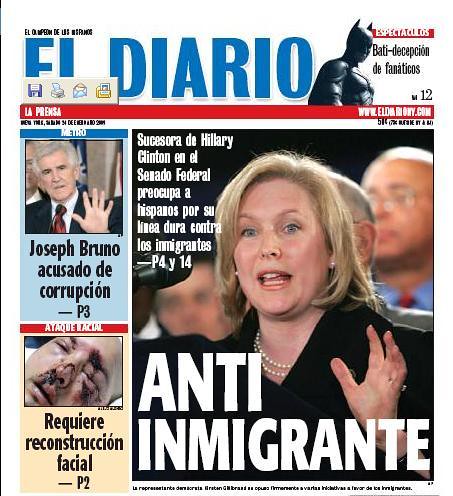
Incoming Sen. Kirsten Gillibrand's photo and the blaring headline "ANTI INMIGRANTE" grace the cover of today's El Diario - just one more example of the hurdles facing the upstate Democrat as she tries over the next 19 months to win over downstate voters in advance of the 2010 primary challenge she is almost certain to face.

eldiario

The accompanying story quotes Assemblyman Peter Rivera, the senior Hispanic member of the state Legislature, who released a statement yesterday slamming Gillibrand, saying he saw "no compelling reason" for the governor to have selected someone whose "hard-line stand" on immigration "borders on xenophobia."

El Diario also quotes from Gillibrand's Web site, which lays out her positions on immigration thusly:

"In Congress, Congresswoman Gillibrand has been a firm opponent of any proposal that would give amnesty to illegal aliens. The federal government must provide the necessary resources to secure our borders, which is critical for America’s economic and national security.


She strongly supports legislation that would significantly increase the number of border patrol agents and place sophisticated technology along the Southern border to catch human and drug smugglers.

Congresswoman Gillibrand authored and passed an amendment that will prevent employers who have hired illegal aliens from receiving federal contracts.

In addition, Congresswoman Gillibrand believes English should be made the official language of the United States and she opposes providing non-emergency taxpayer benefits to illegal aliens. As a Member of the Agriculture Committee, she has advocated for a review of the current H-2A visa system, so that farmers will have access to legal workers when they cannot find Americans to fill their labor needs.

Chung-Wa Hong, executive director of the New York Immigration Coalition called Gillibrand's stances on immigration issues “deeply troubling."

A reader who drew my attention to the El Diario cover also noted the irony in the fact that at the outset of the 53-day Odyssey that was Paterson's search for Clinton's replacement, he talked about the need for the Hispanic community to be better represented in state government.

The need to empower Hispanic elected officials also played a role in the Senate leadership battle, leading to the creation of a new Latino Task Force by Majority Leader Malcolm Smith, which will be led, not by Sen. Hiram Monserrate or Sen. Martin Dilan but by a Gang of Three member, Sen. Ruben Diaz Sr.

The dearth of Hispanic representation in the upper echelons of New York leadership came up again in connection with the selection of a replacement for retired Chief Judge Judith Kaye.

ebenjamin@dailynews.com


Friday, January 23, 2009

Boycott this Racist Baker: N.Y. Baker Makes Racist Cookies, Threatens President

Jan 23rd 2009
By Julie Gerstein

Just in time for Barack Obama's inauguration, Ted Kefalinos, owner of the Lafayette French Bakery in New York, N.Y., is selling atrocious "Drunken Negro Cookies." The offensive chocolate-coated cookies feature an overexaggerated caricature of an African-American face.

And that's not all. Kafalinos, whose cakes were featured in "Sex and the City," was overhead saying that he hoped Obama would follow in assassinated President Abraham Lincoln's footsteps: "He will get what's coming to him." Sounds like a threat to us!

Kafalinos sees nothing wrong with the cookies -- or his remarks. What do you think?

Thursday, January 22, 2009

Diss-Information

My Wish for Obama http://www.babble.com/CS/blogs/famecrawler/2008/08/01-07/barack-obama-family_434x369.jpg


by Jerry Krase


It seems that everybody wants to get into the act now that someone who can think on his own will become the new tenant at 1600 Pennsylvania Ave NW. Even Tom Friedman in his The New York Times opinion piece "Radical in the White House" this morning seems to have oodles of advice for him. First he notes that BHO isn't a "real radical" as the American public was frightened about during the campaign. It sounded up close and personal so I assume that Tom was in DC and attended one or more of the glitzy non-radical post-inauguration events. On the other hand, I took the subway yesterday morning to Manhattan to do some business and hoped to get back in time to watch the inauguration on television with my wife. Across from me on the usually yuppy-packed "F" train was what appeared to me to be a middle-aged African American homeless woman bundled up in an odd collection of winter and summer outerwear. She was fast asleep and next to her sat the usual collection of black plastic garbage bags containing all that she felt worthy of trudging along with her as she traveled on her way to nowhere on a cold and Historic Inauguration Day. She gave off such a foul odor that she had half the car all to herself. A long line of persons of no-color, previously residing in the White House, have found other things too important to consider than her obvious plight. My wish is that Barack Hussein not only remembers the people his predecessors left behind in America, but also comes back to visit them. Now that would really be radical!

Wednesday, January 21, 2009

She's Madame Secretary now.

Hillary Clinton confirmed as Secretary of State by 94-2 vote in Senate

Updated Wednesday, January 21st 2009, 9:24 PM

Gross/Getty

Hillary Clinton (l.), along side her husband, former President Bill Clinton, being sworn in as the next Secretary of State in her Senate office by Associate Judge Kathleen Oberly.

The Senate finally confirmed Hillary Clinton overwhelmingly Wednesday to be America's new secretary of state.

The New York senator, who fell agonizingly short in her quest for the most powerful office on Earth, is now perhaps the most powerful woman in the world.

Less than an hour after the vote, she was sworn in during a private ceremony at her Senate office, attended by husband Bill and her staff.

She immediately sent a letter to Vice President Biden and Gov. Paterson, giving up the seat she won while still First Lady and held for eight years and three weeks.

"This letter is to inform you that I resign my seat in the United States Senate effective immediately in order to assume my duties as Secretary of State of the United States," it read.

Clinton, 61, will be at her new desk at Foggy Bottom on Thursday.

The Senate approved Clinton after a mini-rebellion by conservative Republicans fizzled. Few members from either side of the aisle agreed with their complaint that Bill Clinton's global entanglements could compromise U.S. foreign policy.

The not-so-vast right wing conspiracy mustered just two no votes - Sens. David Vitter (R-La.) and Jim DeMint (R-S.C.).

Even Sen. John Cornyn (R-Tex.), who blocked Clinton from being confirmed with other cabinet members Tuesday, voted yes.

The first First Lady to launch her own political career goes on to inherit one of the toughest foreign-policy portfolios in U.S. history - a fact that prompted even other Republicans to urge a speedy and unanimous vote.

Sen. John McCain (R-Ariz.), the defeated presidential candidate, urged his colleagues to stop dawdling.

"We're in two wars. There's a very fragile ceasefire in Gaza now between the Israelis and Hamas. The situation in North Korea ... seems to have deteriorated," said McCain, pointing to Obama's historic inauguration as evidence the country is tired of bickering.

"I think the message that the American people are sending us now is they want us to work together and get to work," McCain chastised.

Obama quickly signed the papers making the job official. Clinton was sworn in with her right hand on her late father's Bible. The oath was administered by a federal judge, Kathleen Oberly, who was a childhood friend.

Soon after, Clinton headed to the White House for meetings with her new boss. Thursday afternoon, Obama and Biden are due to meet with her at the State Department.

New York's only remaining senator - for the moment - offered one last huzzah to Clinton.

"Colleagues have the right to delay," Sen. Chuck Schumer said earlier in urging the Senate to act. "As a country and as a world, we need Hillary Rodham Clinton as secretary of state given her intelligence, her strength, her compass and her ability to get things done."

mmcauliff@nydailynews.com

Tuesday, January 20, 2009

Mike Lupica

Boxing's renaissance man

Jose Torres commanded

ring & respect

AP

Jose Torres gets over hard right to head of Gomeo Brennan at Miami Beach in 1964.

For the old-timers, the ones who come out of fight nights at the old Garden and out of a much older New York, it will always be 1965 for Jose Torres, when he was young. It will be the night at the old Garden when he beat Willie Pastrano, dancing and jabbing and finally body-punching his way to a TKO. He became the light-heavyweight champion of the world that night and seemed to have won the championship of the city as well. Jose Torres came from Puerto Rico, but by then he was more here than there.

The next day he made his first stop as champ at 110th and Lexington Ave., climbed up on a fire escape and addressed a crowd of thousands.

"This is for everybody," he said, and told the crowd that if he could do something like this in the city of New York, anything was possible.

But he was so much more than just a prizefighter, even if that is how the world first knew him. He became the first Latino columnist in town, at least in an English-language paper, when my old boss, the great Paul Sann, put him to work at the old New York Post. He would later become a commentator on television, and radio host, and in the 1980s even became the New York State Athletic Commissioner.

He was a friend to Norman Mailer, who was once brave enough to get into the ring with him, and Pete Hamill. He once said that Pete had given him his first book and how he now owned more than 800 of them, and was confident that "Pete's responsible for six or seven hundred." He had a good enough voice to sing a ballad one time on the Ed Sullivan Show.

"I keep telling you," he used to say to me, "I am more a lover than a fighter."

Jose Torres wrote books about Muhammad Ali and Mike Tyson, and spent so much time trying to save Tyson from himself and what he called the "parasites" around him. And became a friend to Robert F. Kennedy when Kennedy became the U.S. senator from New York.

Kennedy wanted to learn about the city, to know the city, and not just the avenues of power in Manhattan. So Hamill and the late Jack Newfield became guides for him in those years. So did Jose Torres. They would get in the car at night and drive the neighborhoods of Brooklyn, get out and talk to the people who lived in them. A Kennedy doing this, and the kid from Puerto Rico who had won a silver medal in the '56 Summer Olympics, won the 160-pound division of the '58 Golden Gloves, would later end up in the International Boxing Hall of Fame in Canastota, N.Y.

And Kennedy and Jose Torres would talk through the night. One of the things they talked about was what Robert Kennedy talked about in speeches in those days, about how within 40 years a man of color would be President. It was why Torres thrilled so much to the run Barack Obama made to the nomination and finally to today, even though he was back in Puerto Rico by last year, there to write and grow old as gracefully as he had fought once.

Monday, January 19, 2009

Exclusive Favoritism


The NYPD excluded journalists in a public area of City Hall to benefit a connected news outlet

By Rafael Martínez Alequín

On the morning of Friday, January 16th, Mayor Bloomberg, held a news conference at the Blue Room honoring the first responders to help and save the passengers on the United Airline flight who crash on the Hudson River.
At the conclusion of the News conference NYPD Commissioner Raymond Kelly, accompanied with his security detail and Deputy Commissioner for communication (DCPI) Paul Browne were met by a television crew from channel 5. Commissioner Kelly proceeds to walk out of City Hall. Mr. Yvan Osorio, a freelance cameraman for RCN-TV, as well as this writer we were not allowed to cover the news conference.

Mr. Osorio was stopped by an officer from DCPI from taken images from a conference from police officers as the vestibule in City Hall. The DCPI officer told Mr. Osorio as well as this writer that that news conference was an “exclusive for channel 5." The DCPI officer proceeds to cover the lens of Mr. Osorio’s camera when he tried to take images of the conference. When I approach the officer and I asked for his name, he told me in a threatened matter the he don’t have to give me his named. Meanwhile, his boss, Paul Browne, was there witnessing the DCPI threatening Mr. Osorio. Mr. Ivan Osorio in at telephone conversation stated: “The DCPI officer put his face closed to mine very aggressive to intimidated me.”

The question is when an exclusive interview is done in a public area? Why the NYPD, office of Communication chooses a particular media in a public area for an exclusive? Perhaps, because the Police Commissioner son,Greg Kelly, is a co-host of the morning show for that same network. A network owned by media monopolizer Rupert Murdoch, who also has possession of WOR TV, The New York Post and half of the local weekly neighbor papers in the city.

In the meantime, the denizens of Room 9 in City Hall didn’t pay attention when the NYPD was in clear violation of the first amendments

Hasta Luego mi amigo 'Cheguí'

Puerto Rican boxer Jose

'Cheguí' Torres dies at 72

Updated Monday, January 19th 2009, 5:55 PM

Garrett, Jim

Jose "Cheguí" Torres sparing with Cleo Daniels in a training session before a fight in 1969.

Hall of Fame boxer Jose "Chegui" Torres, the former light heavyweight champion and Olympic Silver Medalist who went on to become a newspaper columnist, author, boxing official and revered representative of the Puerto Rican community, died at his home in Puerto Rico early this morning of a massive heart attack. He was 72.

On March 30, 1965, Torres electrified the Latin American world when he defeated Willie Pastrano by a technical knockout at Madison Square Garden to become the first Hispanic light heavyweight champion.

Before the match, Torres exhibited his fierce pride in his Puerto Rican heritage when insisted he would not get in the ring unless Madison Square Garden officials agreed to play the island's national anthem as well as the Star Spangled Banner. Garden officials agreed.

Torres successfully defended his title three times before losing to Dick Tiger in a close contest in 1966. A Madison Square Garden rematch with Tiger followed a year later. Torres again lost in a close decision, one that so angered his Puerto Rican fans that that city cops had to be mobilized to quell the riot that erupted in the Garden.

Born in Ponce, Puerto Rico, Torres began fighting when he joined the U.S. Army as a teenager. He captured a silver medal at the 1956 Melbourne Olympics while competing for the United States, then won a Daily News Golden Gloves championship in 1958.

After his retirement from boxing in 1969, he launched a second career as a columnist for the New York Post and El Diario-La Prensa and as a representative for the Puerto Rican community. At the Post, he was a sidekick for years of fellow columnist Pete Hamill and writer Norman Mailer.

Torres later chaired the New York State Boxing Commission in the 1980s and served as supervisor for the World Boxing Organization. He also wrote two biographies - "Sting Like a Bee" on Muhammad Ali and "Fire and Fear" on Mike Tyson.

In 1997, he was inducted into the International Boxing Hall of Fame.

"He used his celebrity status to do good for the Puerto Rican community and for all youth," said U.S. Rep. Nydia Velazquez, a close friend of Torres for decades.

Velazquez said she had spoken to Torres's wife of 47 years, Ramona, only yesterday, and learned from her that Torres seemed to be doing well after undergoing hospital treatment for diabetes. Then, around 4:30 this morning, Torres suffered a massive, according to his wife.

He is survived by his wife and four children.

jgonzalez@nydailynews.com

Sunday, January 18, 2009

Mayor Wagner Changed NYC in 1961

Saturday, January 17, 2009

Mayor Wagner 3rd Term Changed NYC . . . Will Bloomberg Do the Same?

by Gary Tilzer

Mayor Wagner started his political career as a protege of Tammany Hall, the Democratic Party machine that had controlled city affairs for most of 150 years. By 1961, he had broken with Tammany and its chief, Carmine G. De Sapio, and defeated that organization. Today NYC is not controlled by a party machine, but by a permanent gang of real estate developers, lobbyists and incumbents who have become the machine designed to keep everyone else out. They have designed election laws that encourage low voter turnout and discourages independent participation in the political process. They have designed a media to act as cheerleaders for their special interests and incumbent elected officials, rather than as objective reporters.

When Bloomberg tried to break NYC's ruling gangs' control by supporting nonpartisan elections, the permanent government teamed up against him and defeated him easily. Wagner in defeating Tammany Hall, launched the Democratic reform movement of the 60's, 70's and 80's that brought a new generation of leaders into local government. These new leaders were the reason for the renaissance and growth of the city which started in the late 70's.

If Bloomberg wants to start an independent party to help him win a 3rd term he should copy the objectives of Mayor Wagner and clean out the political gangs who operate and destroy the process today like Tammany Hall did a generation ago. Bloomberg it is time to Change NYC. What good will a Bloomberg 3rd term do if it leaves in place elected officials who do not know how to rebuild and properly govern New York City *** Bloomy & Tom's 3rd-Party Tag-Team.