When I heard last week about the fatal shooting of four people,
including two pregnant women, by a joint Honduran-U.S. anti-drug raid in
the Mosquito Coast of Honduras, I was only surprised that it hasn’t
happened more often.
The incident, reported by
Fox News Latino
and other media, has sparked angry protests over the American presence
and prompted human rights groups and at least one US congressman to
question US involvement in these operations.
According to US officials,
at about 3 a.m. on May 11, US helicopters carrying Honduran police
officers and DEA agents swooped toward a boat loaded with cocaine in the
Patuca River. As the helicopters approached, people who were loading
the boat fled, but a second boat approached and began to fire, prompting
the Honduran officers to return fire. But
survivors and local residents claim that the agents fired at the wrong boat, killing and wounding innocent people who were returning home from a daily trip.
Anyone who has set foot in the Mosquito Coast in recent years, as I did
in 2006 to investigate illegal logging as a Johns Hopkins’ International
Reporting Fellow, knows that the remote northeast shore has become a
favorite route of transport of cocaine from Colombia and Venezuela to
the United States.
Similar in size to the state of Connecticut, the Mosquito Coast is one
of the most isolated places in Honduras, and its vast stretches of
inhabited terrain of tropical rainforest are accessible only by plane or
boat. It has also traditionally been a hardly policed area with vast
ungoverned areas and little institutional presence.
This last aspect is probably behind the US decision to increase its
logistic support to its Honduran counterparts in the fight against drug
trafficking in the region, and to establish
three new military bases in northeastern Honduras for that purpose.
Its indigenous inhabitants, who have lived in the Mosquito lowlands
and jungles for centuries, are among the poorest in Honduras. Few houses
have electricity, running water or sanitation. Miskitos and other
indigenous people have traditionally lived as hunters, subsistence
farmers, and fishermen, but their survival is threatened by the
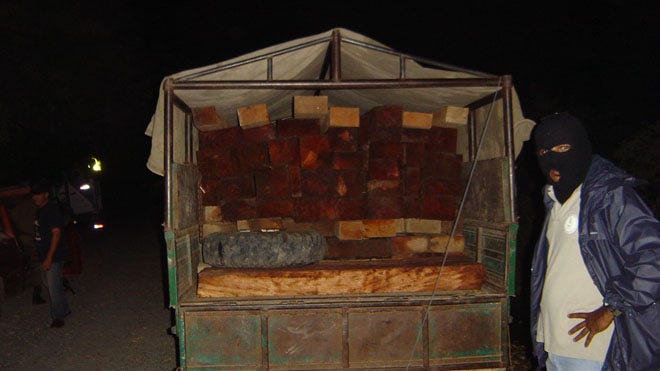
encroachment on their land by illegal loggers, cattle ranchers,
slash-and-burn farmers, and now narco-traffickers.
“Threats by illegal loggers, narco-traffickers and other people are
our daily fare. I have received threats myself,” an indigenous leader
from the Miskito town of Brus Laguna told me then. “A friend of mine had
his house burned down for speaking out against narco-traffickers and
was forced to leave our town for good.”
“We receive a lot of complaints from honest farmers in the region who
are being forced by narco-traffickers to sell their lands for nothing,”
the then Honduras’ head of anti-drug trafficking operations, retired
general Julián Arístides González, told me over a meeting at his
Tegucigalpa office in 2006.
González was murdered by drug mercenaries in 2009, a day after voicing concerns over the alarming rise of landing strips in Honduras.
Corruption of the Honduran security forces was also a major concern for the anti-drug chief.
“When you see a high volume of drug trafficking, like in Honduras, it
means that there is widespread police corruption,” Arístides González
said. Maybe something to keep in mind for the US when supporting
security forces abroad with
dubious human rights records, as is the case of Honduras, according to human rights groups.
When I visited the Mosquito Coast, the presence of drug traffickers
was palpable: their speedboats were parked in the wharfs of the river
towns in broad light; their large cement houses towered over the modest
wooden structures of the typical Miskito home; their semiautomatic
weapons were hardly concealed as they walked through the towns.
Residents knew that narcos from Colombia and Honduras were buying
large houses and tracks of land in the area. There, they cleared areas
of jungle for their landing strips. This put them sometimes in collision
with the Honduran environmental authorities. Their expensive properties
were known among indigenous groups as “narcotierras” or “narco-land.”
The cocaine flights in, clandestine airstrips and even clandestine
landings in official airports were hardly a secret. Residents also
talked about the bales of cocaine that sometimes washed ashore and that
some villagers would collect to resell them to drug traffickers. Some
villagers in the region were also involved in the drug trade, and drug
addiction had also become a problem over the years, especially among the
Miskito lobster divers, many of whom consume cocaine and pot to
alleviate the pain of decompression sickness.
But this doesn’t mean that everyone in the Mosquito Coast was
involved in drug trafficking. I met many humble and honest people who
ran hostels for the tourists, worked as guides or forest agents,
cultivated the land, fished, build canoes, etc. I was moved by their
perseverance in forging a living in this hardscrabble place, despite the
long odds and clear lack of government interest. I witnessed a visit to
Brus Laguna by then President Manuel Zelaya that was so short that
indigenous leaders representing the interests of the 40,000 indigenous
people who live in the region didn’t even have a chance to greet him.
Zelaya left after posing for photographers sent from the capital papers.
“There is nobody here. This is the reality. The Mosquito Coast it
totally neglected by the government,” Osvaldo Munguía, the Miskito
executive director of MOPAWI, an NGO that has worked since the 80s in
the area, told me.
US and Honduran officials have expressed doubts that villagers would
be in the river in the middle of the night, near where helicopters had
landed. They should know better. In this roadless region, the area's
vast lagoons and rivers are precisely their roads and highways.
Residents use boats and dugout canoes to reach the different villages.
Helicopters and planes are too expensive for their inhabitants, most of
whom earn less than $2 a day.
And yes, people also travel during the night, because covering the
distance between one village and another can take up to a day. I
remember coming back by boat from a long trip in the jungle and arriving
at the lagoon in Brus Laguna close to midnight. The light of the moon
showed my Miskito guides the way back. I remember thinking how peaceful
and beautiful the Mosquito Coast was. How warm and welcoming the air of
the lagoon was. I would be scared of repeating this experience now.
To me, the explanations provided so far by the Honduran and US
officials just show their lack of understanding of the realities of life
in the Mosquito Coast. Even if US agents didn’t open fire, they
provided the necessary equipment and support to the Honduran security
forces to do so.
The government of Honduras is sending
a commission of police, judicial and human rights representatives
to the area. The incident should also prompt the US to review its
policy. Militarizing the conflict is likely to result in an escalation
of the violence. Perhaps it’s time for the US to review its policy to
avoid any collateral damage in its war of drugs.
Eva Sanchis' is a freelance reporter in London. Her series on
illegal logging and peasant villages on the Mosquito Coast of Honduras
won the 2006 National Association of Hispanic Journalist Guillermo
Martínez Award for Latin American reporting. The series can be read here. It ran originally in El Diario/La Prensa of New York, and her research there was made possible by a Johns Hopkins International Reporting Fellowship.