Fort Benning, Georgia is famous for it's "School of the Americas", a training camp in torture tactics. Recent reports indicate that it is once again in the spotlight for labor complaints.
Wednesday, January 13, 2010


Tuesday, January 12, 2010
Johnny Liu's name game
Last Updated: 6:33 AM, January 12, 2010
Posted: January 12, 2010
When last New Yorkers got a look into the amazing fantasy world inhabited by rookie comptroller John Liu, he was seven years old and toiling away in a sweatshop.
Or so he claimed in the heat of last year's primary campaign, where shamelessly preposterous assertions are coin of the realm -- and never mind that his own mother said, in effect, "No, Johnny, you never did that."
That must have stung, being outed as a fibber by his own mom -- which maybe explains why Liu is feeling a tad insecure in his new circumstances.
For, as The Post's Chuck Bennett reports, he's ordered staffers to treat him with royal obsequiousness.

AP
Low-level aides and longtime confidants alike must now address him as "Mr. Comptroller" and stand whenever he walks in the room -- a sharp departure from the practice of prior comptrollers, to say nothing of common sense. "We want to address the office with the seriousness it demands," said a spokesman.
Hey, Johnny, news flash: Fancy titles won't make New Yorkers take you seriously -- but doing your job might.
Liu's predecessor, Bill Thompson, managed the city's books with utmost seriousness for eight years -- even as he told staffers to call him "Billy."
But Liu seems to think he's president -- or at least mayor. Indeed, his first major appearance last week, at a teachers-union press conference bashing charter schools, had precious little to do with keeping an eye on the city's books.
Equally odd (if less startling) was the memo he had his top aides distribute to staff last week inviting them to wish the comptroller a happy birthday.
Of course, New York has never lacked for ego-obsessed politicians. Usually, though, they've been in office long enough to compile a bit of a record.
Not so, Johnny Liu -- who needs to break a real sweat doing the job he was elected to do.
Al Franken Pushes Military To Offer Emergency Contraception To Soldiers Abroad
Monday January 11, 2010 4:24 p.m.

Sen. Al Franken, D-Minn., following a series of votes on Capitol Hill, Tuesday, Dec. 22, 2009, in Washington. (AP Photo/Haraz N. Ghanbari)

Al Franken, hot on the heels of his legislative victory to give female military contractors access to the criminal justice system if they are sexually assaulted abroad, turned his eyes this week to the female soldiers who face spotty contraception access and assaults of their own. Franken and Maine Senator Olympia Snowe introduced the Compassionate Care For Servicewomen Act to give servicewomen access to emergency contraception at all military bases--including those that are overseas.
The bill would require that all military pharmacies stock emergency contraception and offer it to servicewomen without a prescription, as the Food and Drug Administration currently allows civilian woman to obtain it. Currently, servicewomen face spotty access to emergency contraception coverage, particularly in facilities abroad, even as they were recently threatened with court martials if their primary contraception failed, if they were sexually assaulted or if they simply failed to use contraception and then became pregnant. Military facilities are not allowed to provide abortion services under federal laws covering Medicaid and Medicare recipients, soldiers and federal employees.
In 2002, the Bush Administration interfered in a Pentagon effort to add emergency contraception to its Basic Formulary, which would have required that all military medical facilities keep it in stock. Plan B was initially approved for sale in 1999 with a prescription, and its manufacturer fought for nearly the entire Bush Administration to get approval to sell it over-the-counter. The Bush Administration's foot- and knuckle-dragging over the issue was spurred on by religious conservatives that oppose all birth control--and Plan B in particular-- as "abortifacients" and a federal judge ruled last year that the Administration's decisions on Plan B were strictly political and not based on sound science.
Like Franken's anti-rape bill, his pro-contraception bill will likely be considered as an amendment to the defense authorization bill, rather than as a separate piece of legislation. It currently has 11 other co-sponsors: Olympia Snowe is the only Republican.
Harry Reid Is Not (That) Racist
Monday January 11, 2010 11:55 a.m.

Photo Credit: Associated Press
Does anyone really believe that Senator Harry Reid is a racist? Seriously? This has everything to do with politics -- Reid's vulnerability on health care, his close Nevada Senate re-election race--and nothing to do with his alleged hatred of African-Americans.
What did he say? Well, in a book to be release on Tuesday, he is quoted as saying (back in 2008) that Obama was only elected because he was a "light-skinned" and didn't have a "Negro dialect, unless he wanted to have one."
"Obviously," writes Joe Klein in Time, "the Republican campaign won't get Reid ousted--although it will hurt his tenuous re-election campaign in an increasingly non-white state." It weakens Reid, who is facing an uphill re-election battle. But unlike former Senate Majority Leader Trent Lott, Reid did not make a roundabout praise of segregation. Nor does Reid have a sketchy past on issues of race.
Senator Reid has already apologized for the clumsy comments which appear in Game Change, a new book by John Heilemann and Mark Halperin. President Obama has accepted the apology. Senate Majority Leader Harry Reid’s office has confirmed that Reid himself was the source of the anecdote. Case closed. Can we all move on now?
Unfortunately, certain Republicans cannot move on. Liz Cheney, for example, sees the dreaded racism; George Will, however, finds none. On This Week with George Stephanoupoulos's roundtable:
WILL: I don't think there's a scintilla of racism in what Harry Reid said. At long last, Harry Reid has said something that no one can disagree with, and he gets in trouble for it.
CHENEY: George, give me a break. I mean, talking about the color of the president's skin...
WILL: Did he get it wrong?
CHENEY: ... and the candidate's...
WILL: Did he say anything false?
CHENEY: ... it's -- these are clearly racist comments, George.
WILL: Oh, my, no.
RNC Chair Michael Steele, who couldn't possibly possess political motivations, also called for Reid to step down for racially insensitive comments during appearances on the Sunday shows.
Does the use of the word "Negro" automatically confer racism upon the speaker? It is a word that carries with it a generational stigma for one, and secondly, technically, the correct word.
Where is Michael Steele with regard to Rush Limbaugh, who played "Barack the Magic Negro" on his show in 2007? As an African-American this is infinitely more offensive than Reid's awkward remarks. And Limbaugh, so far as I know, has never apologized, nor has he been taken to task for it by the right brigade.
New Jersey, outgoing Gov. Corzine expected to legalize medical marijuana
Tuesday, January 12th 2010, 4:00 AM

Holland/AP
Marijuana buds confiscated by law enforcement officers. Outgoing Gov. Jon Corzine is expected to sign legislation before leaving office next week making New Jersey the nation's 14th state to legalize medical marijuana.
Legislators approved a law Monday allowing chronically ill patients to buy up to 2 ounces of pot a month at state-monitored dispensaries.
"I don't think we should make criminals out of our very sick and terminally ill," said Assemblyman Reed Gusciora (D-Princeton), co-sponsor of the bill.
Corzine, who supports the legislation, is expected to sign it into law before turning over power to incoming Republican Gov. Chris Christie, a former federal prosecutor who has voiced concerns over the bill.
The law authorizes the state Department of Health to issue patients with "debilitating medical conditions" like cancer or AIDS the right to legally possess marijuana.
Unlike other states where medical marijuana is legalized, patients will not be allowed to grow their own.
Read more: http://www.nydailynews.com/news/2010/01/12/2010-01-12_new_jersey_set_to_legalize_medical_pot.html#ixzz0cPTdR7Uc
Monday, January 11, 2010
Incumbents Reject Term Limits As a Threat to Their Hegemony, But Public May Raise the Issue As Regard for Officials Wanes
By Henry J. Stern
January 11, 2010
|
|
|
 |
|
In his State of the State message Wednesday, Governor Paterson made one proposal which, if adopted, would change the very heart of New York state politics. For the first time, a governor called for term limits for elected officials: two four-year terms for the governor, comptroller and attorney general; and six two-year-terms for State Senators and Assemblymembers. That comes out to eight years for executives and twelve years for legislators.
Term limits have less chance in the Legislature than the proverbial snowball in hell. What politician with the chance to be re-elected for the rest of his life will vote to make himself ineligible to serve after twelve years? The governor knows that, but he is positioning himself squarely on the side of the angels in what is likely to be a recurring controversy. Term limits would require amendment of the State Constitution, which would have to be preceded by approval by two successive elected legislatures. Unlike the practice in some other states, including California, there is no way for individuals in New York State to place constitutional amendments on the ballot.
But even if passing term limits is a legislative pipe dream, it is still a discussion that voters should engage in seriously, even if their representatives won't. The new possibilities of grassroots organizing through social networking websites has given the public an unprecedented tool to insist that their legislators be more responsive to their wishes. A Facebook page titled CITIZENS FOR TERM LIMITS IN ALBANY has been created to stimulate public discussion on the reform of state government. Hopefully, if more people became involved with this issue, more progress might be made. There is a Youtube video of me speaking on this subject, you can link to it here. It includes a 1965 picture you might find interesting.
Years ago, we were opposed to term limits. It was conventional wisdom that the voters have the right to re-elect or defeat any incumbent, and that term limits deprive them of the ability to retain an elected official whom they want to keep. Term limits were first viewed as a pet project of the billionaire Ronald Lauder, who had been the Conservative Party nominee for mayor against Rudy Giuliani in 1989. The proposal looked to many like an anti-government initiative to frustrate voters' preference.
Although term limits were approved by referendum in New York City in 1993, and reaffirmed by a narrower margin in 1996, the result was attributed to expenditures by Mr. Lauder (which have been dwarfed, however, by personal expenditures in mayoral races since 2001). In order to provide an orderly transition, the Lauder plan provided for term limits to take effect in the 2001 city-wide election. At that time, three quarters of the Council was (were?) term limited out of office, as was Mayor Giuliani. (After 9/11, he might have been able to win a third term. Before the tragedy, that was unlikely.) In 2009, the class of 2001, most of whom were elected only because term limits made their predecessors ineligible to seek re-election, approached the end of their second term. However, at the instance of the mayor, in October 2008, the Council had voted to over-ride the Charter and make themselves, as well as the city-wide officials and the borough presidents, eligible for third terms. Five Councilmembers were defeated in primaries, but most survived. Seven competed for city-wide office, of whom two were elected. The mayor was re-elected, but by a substantially reduced margin, in part because of his manipulation of the term limits issue.
If the mayor had kept the commitment he made in his January 2008 State of the City address, he would have appointed a Charter Revision Commission that year, which would have brought proposals, including the extension of term limits if desired, to a referendum in November which would have cleared the way for a third-term candidacy.
In prior years, the mayor had appointed Charter Commissions under different chairs with varying degrees of success. We are told that private polling indicated that the outcome of a public vote on the third term would be doubtful. For whatever reason, no Charter Commission was appointed in 2008.
If the issue of term limits were put to referendum today in the city, the limits would most likely be approved because disapproval of government is at a height. In the State, there is no provision for such a referendum. Consequently, state term limits are doomed, at least until 2017, when the public will be asked whether it wants a new State Constitutional convention. The last time this question was on the ballot, in 1997, it was defeated after a costly advertising campaign by special interests who feared that their privileged positions might be adversely affected by changes to the state constitution.
There are a number of sound reasons to support term limits, dealing with the fairness of elections. Here, for example, are some advantages incumbents enjoy:
1) Gerrymandering. Sitting members of the legislature draw political districts to suit their own interests. The districts come in odd shapes and sizes, with peninsulas drawn to include an incumbent's home, and sometimes to exclude a potential rival's home from the district. Because it is the leadership of the legislature that ultimately decides what the lines will be, a member cannot act independently too often or s/he will end up without a district to run in.
2) Mailings. Members have the right to send periodic reports to their constituents at public expense. These are usually self-serving brochures, describing the achievements of the incumbent, and illustrated with numerous photographs of you know who. Over the years, these mailings build up name recognition for the incumbent, which give him or her an advantage in an electoral contest with a challenger.
3) Political clubs. The organized party machinery in any district generally supports the incumbent. S/he has made contributions to the party over the years, and is friendly with many of the active members. People take pride in knowing their local elected officials. The relationship, whether it is real or artificial, enhances the constituents' sense of self-importance. They know someone who is in authority, which is preferable to them than not knowing anyone who has influence. If and when there is a challenge, they will stick with the representative they have unless there is some compelling reason not to do so.
4) Constituent service. Legislators have staffs and district offices, paid for by the state. These offices handle matters where individuals seek help from their representative, sometimes in dealing with federal, state or city agencies, at other times with personal issues or making referrals to other offices or social service providers. They may help people not fluent in English, or persons with disabilities. The passage of time increases the number of people who will be served by these offices, and those people are more likely to vote for the incumbent who has helped them.
5) Lobbyists. It is the practice of many lobbyists to make regular contributions to politicians, primarily those of the majority party. They comprise the bulk of the donors at fund raisers held in Albany, where few downstate contributors venture in the winter. An expectation arises that the incumbent will not vote against the interests of the donors, whether they are business corporations, public employee unions, or others particularly affected by legislative decisions. Having taken money over the years from these special interests, some legislators believe it would be unethical to bite the hand that has been feeding them. Sometimes huge donations are made, as when Senator Bruno's son was hired by Cablevision, which blocked the construction of a West Side stadium because it would compete with Madison Square Garden, which they own.
6) Media. Newspapers, television and radio stations report on the activities of incumbents. A challenger, unless he is already well-known, has a relatively brief time to attract public attention in a political campaign. The networks of relationships that incumbents have built over the years are very difficult to overcome by a new candidate, who basically starts from scratch in terms of public recognition.
7) Leadership protection. One reason Speaker Sheldon Silver remained in power is that he protected his members, a function he performed well. For example, on the controversial issue of congestion pricing, he did not allow the bill to come to the floor, so his members did not have to cast individual votes on the proposal. This protected them from the wrath of the editorial boards who were for the plan, while many of their constituents were against it. Silver took the rap for killing the plan, and the Democratic caucus, which elects him every two years, was grateful that their members did not have to vote on an issue which could lead to a primary challenge. That is one of the reasons they supported him, apart for concern over their own advancement or blacklisting.
For all those reasons, incumbents have an enormous advantage and are generally re-elected, unless they have done something outrageous. Even then, they often win.
The problem resulting from the numerous advantages of incumbency is that people who seek a particular elected office for a lifetime, and will depend on its income, both direct and indirect, to support their families, will make decisions on the basis of what will preserve, protect and defend their careers, which are their and their families' livelihood. They lose the ability to make judgments on the merits of legislation, even if they were able to discern the merits, an ability which often eludes them. Their support for a measure is the property of their leaders, and is bargained for and bought (or rented), usually not directly but as part of larger arrangements.
The result is that decisions are not made by citizen-legislators, who know they will return to their own profession, but by professional representatives, dedicated to promoting and extending their own careers, and willing to make decisions which will help them to pursue that goal.
Another problem is that, after many years, people go stale in office, offer fewer bills, and become more withdrawn from the public. Some lose their energy or faculties as they grow older; that happens naturally to the human animal. The average age of Republican state senators last year was in the '60s, with many holding on for years after they could retire in order to save their seats for the party. An open seat is more likely to swing to another party than an occupied seat.
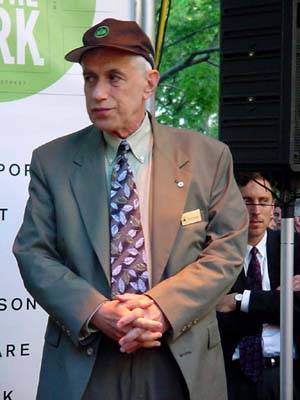
SORRY ABOUT THAT: In last Thursday's article, we suggested that former Comptroller Bill Thompson become a judge. We assumed that as the son of a prominent Justice of the State Supreme Court and a longtime public official, he was a lawyer. We were wrong. Thompson is a graduate of Midwood High School and Tufts College, class of '74. Tufts is a fine college. On graduation, Thompson went right into politics, serving for eight years as an assistant to Brooklyn Congressman Fred Richmond. Later he was Deputy Borough President of Brooklyn under BP Howard Golden. He was president of the New York City Board of Education from 1996 to 2001, in the years just before mayoral control. He was elected Comptroller in 2001 and re-elected in 2005. We meant the suggestion for a judicial appointment as a compliment.
We want to thank the readers who called the error to our attention, in order of the e-mails they sent us, they are: Michael Oliva, John Tepper Marlin, Arthur Greig, Hon. Mark Friedlander, Allen Bortnick, Joyce S. Johnson, Jeanne Millman, Hon. Richard Weinberg, Hon. Joseph S. Levin, Hon. Richard A. Brown and Hon. Milton Mollen. It is when we make mistakes that we find out how many distinguished people are among our readers.
Sunday, January 10, 2010
Paterson, Again, Slams Legislators, Goo-Goos 'Drunk With Power'
By Azi Paybarah
January 7, 2010 | 9:28 a.m.

Azi Paybarah
In an interview with Errol Louis on WWRL 1600 this morning, Governor David Paterson slammed state lawmakers for trying to sneak "behind my back" an ethics reform bill that he said won't solve any problems in the capital.
The governor also criticized the existing standing committees charged with monitoring ethical violations, which have yet to discipline a slew of lawmakers who have run afoul of the law (Joe Bruno, Hiram Monserrate, and others).
"There is a standing legislative ethics committee and I'm wondering what you'd ever had to do to get them to meet and police themselves," Paterson said
"You've got a situation where the legislators will not turn on each other and discipline each other and we've disgraced ourselves," he said.
When Louis said the "moneyed interests" in attendance for the governor's speech yesterday didn't like what they heard, Paterson agreed, and said, "They went right over and patted the legislators they control on the shoulder and go out and make nasty remarks about me after I made the speech."
Later, Paterson dismissed the rival ethics proposal state lawmakers had been working on.
"What the Legislature was planning on doing was putting a couple of bandages on the problem and sneaking it in behind my back," Paterson said.
His own plan, he said, would even monitor good government groups, "which they won't like," he said, noting his bill calls for requiring the groups to make public who their funders are.
"Here are good government groups who are always talking about what government is doing, and no one knows who their donors are," Paterson said. "It's about time they realize they have been drunk with power, just like the legislators."
Paterson is doing a round of radio interviews this morning, which are keeping a few reporters busy this morning.
Saturday, January 9, 2010
Giuliani Comments on GMA Prompt Debate
January 08, 2010 2:31 PM
There’s a lot of chatter out there about former New York City Mayor Rudy Giuliani’s appearance on Good Morning America where he told George Stephanopoulos “we had no domestic attacks under Bush -- we’ve had one under Obama.”
Obviously this ignores a certain horrible event on September 11, 2001.
This did not escape the White House’s notice.
“There were a number of things that didn’t quite seem to jive with the better part of reality,” White House press secretary Robert Gibbs said at Friday’s briefing. “I think he mentioned there not being any domestic terror attacks in the previous administration... It’s interesting that the mayor of New York had forgotten that.”
A spokesman for the former Mayor clarifies, saying that the remark “didn't come across as it was intended” and that he was “clearly talking post-9/11 with regards to Islamic terrorist attacks on our soil.”
By “on our soil,” the former mayor is not including either Umar Farouq Abdulmutallab’s failed Christmas Day attack or Richard Reid’s December 22, 2001 attempt to blow up American Airlines Flight 63 from Paris to Miami.
So the spokesman says that the “one” attack that Giuliani says took place during the Obama administration was a reference to the alleged Fort Hood shooter, Major Nidal Hasan.
Some might argue, however, that even with this quite significant clarification, Giuliani is ignoring some other acts of terrorism:
• Hesham Mohamed Hadayet, an Egyptian national who on July 4, 2002 shot and killed two Israelis and wounded four others at the El Al ticket counter at Los Angeles International Airport. The FBI would later say Hadayet was motivated by opposition to Israel and US policy in the Middle East and the shootings fit the definition of terrorism.
• The 2001 anthrax attacks, which killed five people;
• DC sniper John Allen Muhammed, who killed at least 10 people in 2002 and was convicted by a Virginia court of terrorism, among other charges.
It’s worth noting, however, that neither the anthrax killer nor the DC sniper were firmly established as having been motivated by extremist Muslim ideology.
-jpt
UPDATE: The Giuliani spokesperson says the former Mayor does not consider the events with Hadayet, Muhammed, or the anthrax attacks Islamist terrorist attacks since "he was referring to what are known islamic terrorist attacks."
ALSO: My colleague George Stephanopoulos adds that critics who say he should have pressed Giuliani on this misstatement in the moment “are right.”
Friday, January 8, 2010
Koppell: On Armory, Administration ‘Bargaining in Bad Faith’
THURSDAY, JANUARY 7, 2010
 |
Earlier that week, Koppell held a town hall meeting in Bedford Park where he verbally tussled with constituents who were virtually unanimous in their position that he should vote the plan down if it didn’t include a living wage provision.
“If you want to be responsible for an empty building for the next 10 years, that’s you,” Koppell told his audience then. “I don’t want to be responsible for that.”
Add to those concerns Koppell’s support of Mayor Bloomberg in the November election and you’ve got the Bronx Council member most likely to give the project a green light.
But when the vote came, he voted with the Bronx delegation and 44 of his colleagues, in a stunning rebuke of Mayor Bloomberg and one of his top outer-borough economic development priorities.
We called Koppell a few days ago and asked him why he voted the way he did.
“I wanted the project to go ahead,” Koppell said, “but I hadn’t made up my mind because we were involved with quite lengthy negotiations with the city to try and get some concessions on the living wage.”
Koppell said the negotiations with the Bloomberg administration were “going ahead fairly positively until Friday [the vote was on Monday], and then at the last minute, the administration took all of their tentative offers off the table, and wanted us to proceed with no concession on living wage,” and no progress on other matters either.
One of those tentative offers was the creation of a fund from the sale price of the building to subsidize merchants so they could pay their wokers the living wage -- $10 an hour plus benefits – demanded by elected officials and the Kingsbridge Armory Redevelopment Alliance.
On the day of the vote, Council Majority Leader Joel Rivera told the press that the city’s top lawyer said that one of the offers – giving direct financial to eligible workers – might run afoul of the state Constitution .
But Koppell, a former state attorney general, said he believes even that “could have been worked out in my opinion if the city and Related wanted to proceed with it.”
Koppell said there were other benefits under discussion including a provision for Bronx purchasing and hiring Bronx workers. “They were on the table and maybe they could have been worked out,” he said. “When the other two matters were taken away everything fell apart.”
Thursday, January 7, 2010
AG Cuomo turns up heat on Sen. Pedro Espada with new subpoena over Senate expenses
Wednesday, January 6th 2010, 9:30 PM

Smith for News
Senate Majority Leader Pedro Espada is being asked to provide financial information and communications related to the Bronx clinic he founded ALBANY - Attorney General Andrew Cuomo stepped up his probe of Senate Majority Leader Pedro Espada Wednesday with a new subpoena.
Cuomo's office is seeking a broad range of materials related to the Soundview Health Care Network, the Bronx clinic Espada founded, and his legislative member items, three sources said.
The subpoena, served to the secretary of the Senate's office, asks for information about Espada's financial disclosure forms and Senate expenses, the sources said.
It seeks all mobile communications like e-mails, text messages and cell phone records for Espada and his staff.
"It's a kitchen sink kind of thing," one source said. Cuomo's office has been looking into whether Soundview misused funds to aid his political campaign.
Investigators are believed to be probing how Espada operates Soundview, how the network is funded, and whether he mixed Senate expenses with his Soundview role.
There are also questions about whether Espada omitted information from financial disclosure forms filed with the state.
"The investigation is wratcheting up," a second source said.
Cuomo's office has been probing Espada for months, but this is the first subpoena to the Senate.
Espada, a Bronx Democrat, last year gave $1.77 million in taxpayer money he controlled to the New Bronx Chamber of Commerce. The organization asked for just $50,000.
The gift came after Senate Democrats rejected Espada's bid for $2 million for two nonprofits linked to Soundview, Green Eco. Energy Inc. and Bronx Human services Council Inc., a source said.
Espada denies any wrongdoing.
Confessore & Hakim report: “Attorney General Andrew M. Cuomo subpoenaed the New York Senate on Wednesday for a broad range of e-mail messages and other records concerning Senator Pedro Espada Jr., the Bronx Democrat who led a monthlong coup that brought state government to a standstill this summer, Mr. Espada said. Mr. Cuomo has been investigating Mr. Espada for months in cooperation with the Bronx district attorney, Robert T. Johnson, over matters including political activity by employees of health clinics he founded and whether he resides in his Bronx Senate district. The latest subpoena focuses on the health clinics, which are part of the Soundview HealthCare Network, and Mr. Espada’s efforts, since winning office two years ago, to obtain Senate earmarks and other state grants.”
Monday, January 4, 2010
Transgender Woman Named to Commerce Post
David Knowles
Writer
(Jan. 4) -- President Barack Obama has selected Amanda Simpson as a senior technical adviser to the Department of Commerce, making her the first transgender appointment of his administration.
"I'm truly honored to have received this appointment and am eager and excited about this opportunity that is before me," Simpson said in a news release posted at the National Center for Transgender Equality's Web site. "And at the same time, as one of the first transgender presidential appointees to the federal government, I hope that I will soon be one of hundreds, and that this appointment opens future opportunities for many others."
Simpson has worked for over 30 years in the defense and aerospace industries, most notably at Raytheon, the news release said. A former military test pilot with degrees in physics, engineering and business administration, Simpson was named a "Woman on the Move," by the YWCA in 2004, and received Arizona's Human Rights Foundation Individual Award in 2005.
Outandlegal.org
Amanda Simpson is the first transgender person to be appointed by the Obama administration.
Simpson was the first transgender person to win a primary election when she became the Democratic nominee running for a seat in the U.S. House of Representatives in Tucson. She later lost her bid to become the first transgender member of Congress. In 2002, she made the transition from male to female, undergoing gender reassignment surgery while at Raytheon.
"Amanda is incredibly smart and capable," said Mara Keisling, executive director for the National Center for Transgender Equality, where Simpson has served as member of the board of directors for the past three years. "This was a merit-based appointment. What's significant about it is that we finally have an administration in which being transgender isn't a disqualifying factor for a job."
Appearing in a television forum in 2008, Simpson detailed her own experience as a transgender woman:
Filed under: Nation
2009 AOL Inc. All Rights Reserved.
Rep. Charles Rangel says Andrew Cuomo won't dare run against Gov. Paterson
 Smith for News
Andrew Cuomo (left) with Rep. Charles Rangel in 2006. Cuomo might run
against Gov. Paterson.
"People have almost forgotten he ran against Carl McCall," said Rangel.Running against Paterson would undo the years of hard work Cuomo put in to improve his standing with black voters, Rangel said. Cuomo was in the Democratic doghouse after his failed long-shot 2002 primary challenge to then-state Controller Carl McCall - at the time New York's highest-ranking black elected official and first black major party gubernatorial candidate.
"[Cuomo's] done a great job as the attorney general, and he's mended fences. ... I just don't see how he could possibly run against Paterson."
Asked if he believes the poll-challenged Paterson will run, Rangel replied, "I cannot get caught in a position to say David Paterson doesn't mean what he's saying."
Rangel's decision to play the moral race card is the latest salvo by old-guard Harlem Democrats to try to prevent Cuomo from running against Paterson.
Last summer, Rangel - the subject of a longstanding House ethics committee investigation - warned of "racial polarization" if Cuomo runs. The congressman also insisted the attorney general had personally assured Rangel he would "not be a candidate against the governor."
Late last month, Basil Paterson, the governor's father and a longtime Rangel ally, said on New York 1 that Cuomo's 2002 run against McCall had left a "sour taste" among black voters and suggested a repeat performance by the attorney general could cost him the black vote.
The Cuomo camp declined to comment on Rangel's latest slam.
In September, Cuomo's stealth campaign for governor got a boost when President Obama's political director, Patrick Gaspard, expressed concern to Paterson about his low poll numbers and said the White House would prefer he not run.
Paterson's poll numbers have improved, but he continues to trail Cuomo by double digits in polls. The governor is also likely to lag Cuomo in the Jan. 15 campaign finance filings. Cuomo is expected to have more than $16 million on hand, while Paterson, who has been running TV ads since November, could have as little as $5 million.
The field of possible contenders broadened yesterday when Democratic Suffolk County Executive Steve Levy announced he'd created an exploratory committee for a potential gubernatorial run.
Levy is the highest-ranking elected official of New York's largest suburban county, but he is not well-known outside Long Island. His conservative stance on illegal immigration has made him the object of criticism, but he is a prodigious fund-raiser and had $4 million in his campaign committee in November.
A consultant to Levy, who ran for reelection in 2007 on the Democratic, Republican, Independence and Conservative lines, said the county executive would "seriously consider" cross-endorsements if he runs.
Levy refused to criticize either Cuomo or Paterson yesterday, but said he believes he has the "best skill set" to lead the state. "If there was ever a time that the state needs executive and management skills, it's now," he said.
Levy's consultant, Michael Dawidziak, was less cautious.
"Voters are four years older, four years wiser and four years down the road to maybe not picking somebody who's a second-generation, blue-blood politician," Dawidziak said. "That was the mistake in picking [Eliot] Spitzer."
Saturday, January 2, 2010
Robert Morgenthau Goes Out on a Roll After five decades, the D.A. who did it his way packs up
By Tom Robbins
Tuesday, December 29th 2009 at 3:07pm
-
Stan Shaw

Part of the rap on Robert Morgenthau was always that he was this aloof, patrician prosecutor. Critics liked to peg the Manhattan District Attorney as an elite upstate apple farmer, someone out of touch with everyday New Yorkers and happy to pull his punches for those in his lofty social circle.
If this were all true, then, by rights, Bob Morgenthau should have gotten along famously with Mike Bloomberg, the wealthiest mayor ever and New York's richest citizen with his own sprawling estate north of the city.
As it happens, the two men never had any use for each other. The way Morgenthau tells it, he tried several times over the years to engage Bloomberg about one of his biggest gripes: the billions hidden in off-shore tax havens by the wealthy. Whenever he brought up the subject, said Morgenthau, the mayor would look at him blankly. "I said, 'This is tax evasion, using off-shore accounts out of our jurisdiction.' And he says to me, 'I pay my taxes.' I said, 'Mike, nobody is suggesting you don't pay your taxes.' And he says, 'I am glad I'm not a lawyer.' I had three separate conversations with him, with almost identical language over several years."
Morgenthau said he never figured out what to make of it. He also tried to get Bloomberg and his team interested in the problem of the burgeoning underground economy, which pulls more tax dollars out of the city's coffers. "There was just no interest," he said.
A couple of years ago, Morgenthau said, he had an interesting conversation with one of the mayor's budget advisers. "He said to me, 'Do you want to have the reputation of someone who just goes after cases in order to collect taxes?' And I said, 'You're goddamn right I do. You let me worry about my reputation, and you worry about yours.' "
These tasty morsels of mayoral-D.A. acrimony only surfaced in the wake of the public fight that the mayor picked earlier this month as Morgenthau was preparing to leave office after 35 years. Bloomberg claimed Morgy was short-changing the city in the payout of hundreds of millions of dollars in fines collected by his office from tax cheaters and banking scamsters. The mayor's people weren't especially interested in making sure these fines got levied, only that they got the lion's share of the dough.
The fight didn't even go one round. First, Morgenthau beat Bloomberg on legal grounds, winning a new state law that mandates a 50-50 split between city and state. Then he handed Bloomberg a worse drubbing on the public relations front, forcing the newly re-elected mayor to sue for peace.
It wasn't a bad last act for New York's longest-serving lawman. Thursday is Morgenthau's last day in the eighth-floor office on Hogan Place where he's been presiding since 1975, back when Bloomberg was still making trades at Salomon Brothers. The job was already his second stint as a prosecutor. In 1961, when he was 42 years old, Morgenthau was picked by his friend John F. Kennedy to serve as Manhattan U.S. attorney.
Back then, he met with similar scorn: He was an aristocratic crony who wouldn't know a gangster if he tripped over one on Mulberry Street. He went on to make more cases against organized crime than the entire Justice Department. He had the first Mafia defector, a Genovese crime family hoodlum named Joe Valachi. That kind of catch would give most prosecutors permanent bragging rights. Morgenthau wasn't impressed, then or now. "He was kind of like the doorman, or the elevator operator," he said. "He could say I saw so-and-so, but he didn't know a hell of a lot."
As for rolling over for his powerful friends, when the Kennedy family counselor, a man named James Landis, was found to have failed to file tax returns, everyone from the Attorney General on down bolted for the door, quickly recusing themselves. Morgenthau shrugged and got a conviction.
Before his tangle this month with Bloomberg, his most famous political feud was with a president. When Richard Nixon was elected in 1968, Morgenthau had such a healthy distrust of his new boss that he refused to graciously hand in his resignation, the way U.S. attorneys are expected to do when a new president takes office. "If he'd offered me the job, I wouldn't have taken it," he said later.
Last week, he sat at the end of a long wooden table in the big office on Hogan Place. At the other end of the room, his desk was still piled high with papers. A small mountain of documents cascaded from a wing chair. There were several glass bookcases, all packed away and empty now, save for a couple of rows of law books. The walls were still lined with photos and memorabilia. Most had yellow tags on them, reading "Property of RMM."
There is a shot of the prosecutor campaigning with JFK in the Bronx, confident smiles worn by all. There is an arms-around pose with a law-school friend, Byron White, the Supreme Court justice known as "Whizzer" when he was an All-American football player at the University of Colorado. "I'd go down to see him at the Supreme Court. He'd walk down the hall with an open can of Budweiser. He was no bullshit," Morgenthau said.
An earlier generation of public servants took up most of a wall: Herbert Lehman, a great-uncle and former governor; a grandfather, Henry, photographed in Constantinople, where he was American ambassador and where he blew a lonely whistle on the Armenian massacre in the first World War. There is a note from the British foreign secretary, Lord Halifax, to his father, Henry Morgenthau, a member of Roosevelt's cabinet who championed early-wartime aid to Britain: "We cannot publicly acknowledge your assistance, but we hope the day will come when you will visit us and receive the thanks we owe you."
There is a picture of the U.S.S. Lansdale, where his own war was fought. The ship was escorting a convoy when it was sunk by a Nazi aerial torpedo in the Mediterranean in 1944. Morgenthau tread water for hours. Alongside, the S.S. Paul Hamilton went down with 580 men. "I made a lot of promises to the Almighty without a hell of a lot of bargaining position," he said.
"Well, you gotta be lucky," he added, staring at the photo. Still, he managed to go places where luck was required. "That's the Harry F. Bauer," he said, pointing to another black-and-white photo. "We went out to the Pacific on that. Shot down 17 Japanese suicide planes. We got the Presidential Citation for Okinawa."
This may be part of the reason why incoming fire from mayors and tycoons failed to rattle him. A few years back, he infuriated a good chunk of the city's business establishment by exposing a cozy system of bribery among contractors and building managers. Loud grumbling was heard after indictments sullied many big names. The D.A. responded with a rare lecture, a punch aimed at the permanent government's midsection: New York, he warned, was becoming "Kickback City."
He would have been delighted to keep making such cases except that he turned 90 this summer, the only clock that told him it was time to go. "You'll be seeing me around," he said at the door. "I'm going to stay active." On the radio on Sunday, Bloomberg announced that he is looking for some good volunteers to engage in public service to help the city. Maybe the now-retired D.A. can spare the mayor a few afternoons to show him how it's done.
Make the case against Hiram: Senate panel has plenty of reasons to expel Monserrate
Daily News
Saturday, January 2nd 2010, 4:00 AM
A state Senate committee's draft report on Hiram Monserrate, unfortunately leaked rather than openly shared with the public, confirms what we already knew: He is a lying brute unfit to stay in the Legislature.
The panel starts with Monserrate's misdemeanor assault conviction, for manhandling his girlfriend after her face was slashed, then highlights other wrongdoing.
It faults him for not calling 911. For needlessly dragging her to a hospital 37 minutes away instead of to the nearest emergency room. For telling flagrant lies about what happened.
At his trial, Monserrate was acquitted of a felony because the judge found reasonable doubt that he had intentionally cut Karla Giraldo's face. Had that verdict gone the other way, Monserrate would have automatically been ejected as a felon.
Foolishly, in appointing a committee to study the case, the Senate chose not to reexamine how Giraldo's face came to be injured. Yes, Monserrate may have been acquitted using the high standard of proof in criminal court - but it would have been fair and proper to ask whether he is guilty based on a preponderance of the evidence. We believe he is.
Still, focusing on lesser offenses, the panel is expected to recommend either removal from office or a serious censure. If so, it must explain why - clearly and rigorously. Using standards that can be defended in this and future cases.
The precise offense must be thought through and thoroughly articulated, lest this be dismissed as another sloppy act of petty, personal politics. Then, the full Senate must hold an up-or-down vote on all options - starting with expulsion.
Thursday, December 31, 2009
Expulsion possible for state Sen. Hiram Monserrate in wake of conviction of assaulting girlfriend
Thursday, December 31st 2009, 4:00 AM

Bates for News
State Sen. Hiram Monserrate may be losing his Albany seat in the wake of his assault conviction. ALBANY - A special Senate committee is likely to recommend lawmakers consider ousting state Sen. Hiram Monserrate for beating up his girlfriend, the Daily News has learned.
The committee, which has been reviewing the Senate's options regarding Monserrate since his conviction on assault charges, agrees he must be punished.
It expects to offer at least two options, one of which will be expulsion, a source with knowledge of the deliberations said.
Another recommendation will be some sort of censure, he added.
"It's very likely there will be a recommendation that some sanction be imposed and among the options presented will be expulsion," the source said.
The committee wants the Senate to consider each option, rather than "pick and choose," the source said. A final determination is expected next week.
Senate Democratic Conference Leader John Sampson has not said if he will let lawmakers vote on a resolution calling for Monserrate's expulsion.
"We are waiting for a full, finalized report," a spokesman said.
One Senate Democrat predicted ousting Monserrate would have "overwhelming" support but that Sampson was reluctant.
Monserrate, a Queens Democrat, was convicted in October of misdemeanor assault for slashing girlfriend Karla Giraldo in the face with a broken glass last December.
The committee, headed by Sen. Eric Schneiderman (D-Manhattan), determined that Monserrate failed to take responsibility for his actions and suggested he was not telling the truth when he claimed the slashing was an accident.
Tuesday, December 29, 2009
Hiram Monserrate's Christmas Party Crashed By Gay Activists
Monserrate, who was convicted of misdemeanor assault charges in October for "unintentionally injuring girlfriend Karla Giraldo while dragging her through his apartment lobby," has been a target of the gay community since he voted against gay marriage earlier this month. The Queens lawmaker initially voiced his support for the bill.
Members of the LGBT activist group The Power disrupted the Queens party with anti-Monserrate cries referencing his assault trial and his broken promises to the LGBT community.
One activist screamed out, "It's the one-year anniversary of Hiram slashing his girlfriend! Hiram's a wife beater! He can get married and we can't!"
A video released by the activist group shows the protesters being ushered out of the building and confronting Monserrate's openly gay chief of staff Wayne Mahlke.
WATCH:
Your request is being processed...
|
|
|
|
|
|
|
|
|
Senate Report Rebukes Monserrate, No Sanctions...Yet
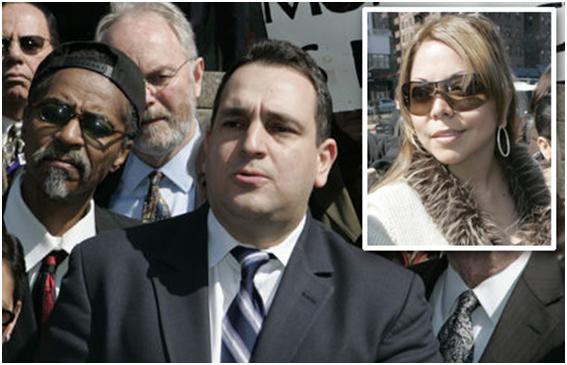
A harshly-worded report by a special Senate committee all but accuses Sen. Hiram Monserrate of lying about the "accident" that left his girlfriend with a laceration on her face and rebukes him for failing to take full responsibility for the incident, according to a source familiar with the document.
The 55-page draft report rehashes the events of Dec. 19 that led to Monserrate's arrest and eventual conviction on a misdemeanor charge of assaulting Karla Giraldo.
It does not make any recommendations about whether the Queens Democrat should be further punished - either by censure or expulsion from the chamber - by his colleagues.
Members of the Senate committee created this fall to review Monserrate's case reviewed the report behind closed doors for three hours today. They will suggest changes and come to a determination about Monserrate's fate in the coming weeks.
The committee subpoenaed all the testimony and documents related to the grand jury that handed up felony assault charges against Monserrate, but was only granted access to some of what it sought - including Giraldo's testimony.
Neither Monserrate nor Giraldo agreed to cooperating with the committee, despite a pledge by the senator and his attorney to do so.
After reviewing Giraldo's testimony, the committee found many holes in her story and ultimately rejected her version of what happened on Dec. 19 as "inconsistent and unreliable," the source said.
The committee blasted Monserrate for failing to accept responsibility for his actions in numerous interviews that followed his conviction. It took particular issue with the fact that he has refused to call what happened between himself and Giraldo domestic violence.
The committee itself has no power to do anything to Monserrate. It can merely recommend actions to be voted on by the full Senate. A source knowledgeable about the committee's proceedings said its members are "moving toward broad consensus" about calling for action to be taken against the senator.
Sen. Eric Schneiderman, who chaired the Monserrate committee, said the members are "moving ahead" and "close to wrapping up." He refused to reveal whether the committee would recommend ousting Monserrate, saying only: "That won't be discussed until we finalize the report."
Scheiderman said he hopes the report will be finalized "in the next week or so." Senate Democratic Conference Leader John Sampson said yesterday the committee won't likely complete its work before this year draws to a close at the end of the week.
- The DN's Kate Lucadamo contributed to this report.
Subscribe to:
Posts (Atom)