Saturday, July 6, 2013

Venezuela, Nicaragua and Bolivia offer asylum to Edward Snowden

President Maduro offers to protect NSA whistleblower 'from persecution by the empire' and rejects US extradition request
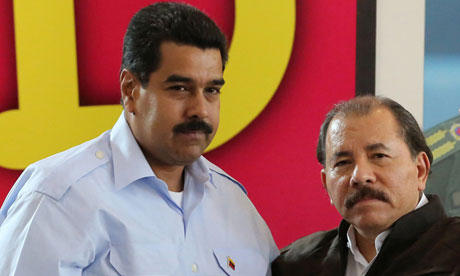
Venezuelan president Nicolas Maduro and Nicaraguan counterpart Daniel Ortega
Venezuelan president, Nicolas Maduro (L), and his Nicaraguan counterpart, Daniel Ortega, who have offered asylum to Edward Snowden. Photograph: Inti Ocon/AFP/Getty Images
Bolivia, Venezuela and Nicaragua have offered asylum to Edward Snowden, the US whistleblower who is believed to have spent the past two weeks at a Moscow airport evading US attempts to extradite him.
The Venezuelan president, Nicolas Maduro, and his Nicaraguan counterpart, Daneil Ortega, made the asylum offers on Friday, shortly after they and other Latin American leaders met to denounce the diversion of a plane carrying the Bolivian president, Evo Morales, due to suspicions that Snowden might have been on board.
Shortly after, Morales also said Bolivia would grant asylum to Snowden, if asked. On Saturday, Venezuela's offer was given a warm reception by an influential member of the Russian parliament.
In a tweet, Alexei Pushkov, chairman of the Duma foreign affairs committee, said: "Asylum for Snowden in Venezuela would be the best solution."
The invitations from South America came as Snowden sent out new requests for asylum to six countries, in addition to the 20 he has already contacted, according to WikiLeaks, which claims to be in regular contact with the former National Security Agency contractor.
Most of the countries have refused or given technical reasons why an application is not valid, but several Latin American leaders have rallied together with expressions of solidarity and welcome.
"As head of state of the Bolivarian republic of Venezuela, I have decided to offer humanitarian asylum to the young Snowden … to protect this young man from persecution by the empire," said Maduro who, along with his predecessor Hugo Chávez, often refers to the US as "the empire".
The previous day, Maduro told the Telesur TV channel that Venezuela had received an extradition request from the US, which he had already rejected.
A copy of the request, seen by the Guardian, notes that Snowden "unlawfully released classified information and documents to international media outlets" and names the Guardian and the Washington Post. Dated 3 July and sent in English and Spanish, it says: "The United States seeks Snowden's provisional arrest should Snowden seek to travel to or transit through Venezuela. Snowden is a flight risk because of the substantial charges he is facing and his current and active attempts to remain a fugitive."
It adds that he is charged with unauthorised disclosure of national defence information, unauthorised disclosure of classified communication intelligence and theft of government property. Each of these three charges carries a maximum penalty of 10 years imprisonment and a fine of $250,000.
Describing Snowden as "a fugitive who is currently in Russia", it urges Venezuela to keep him in custody if arrested and to seize all items in his possession for later delivery to the US. It provides a photograph and two alternative passport numbers – one revoked, and one reported lost or stolen.
Maduro said he did not accept the grounds for the charges.
"He has told the truth, in the spirit of rebellion, about the US spying on the whole world," Maduro said in his latest speech. "Who is the guilty one? A young man … who denounces war plans, or the US government which launches bombs and arms the terrorist Syrian opposition against the people and legitimate president, Bashar al-Assad?"
The Bolivian government, which has said it would listen sympathetically to an aslyum request from Snowden, said it too had turned down a pre-emptive US extradition request.
Ortega said Nicaragua had received an asylum request from Snowden and the president gave a guarded acceptance.
"We are an open country, respectful of the right of asylum, and it's clear that if circumstances permit, we would gladly receive Snowden and give him asylum in Nicaragua," Ortega told a gathering in Managua.
So far, the countries that have been most vocal in offering support are close allies of Venezuela. Ecuador has also expressed support for Snowden, though the government there has yet to decide whether it would grant aslyum. It is already providing refuge for the WikiLeaks founder Julian Assange, who has been in the Ecuadorean embassy in London for about a year.
Many in Latin America were furious when the Bolivian president's flight from Russia was denied airspace by European countries, forcing it to land in Vienna, where Morales had to spend more than half a day waiting to get clearance to continue his journey.
Morales said the Spanish ambassador to Austria arrived at the airport with two embassy personnel and asked to search the plane. He said he refused.
The Spanish foreign minister, José Manuel García-Margallo, acknowledged on Friday that the decision to block Morales plane was based on a tip that Snowden was on board.
"They told us that the information was clear, that he was inside," he told Spanish TV, without clarifying who the tip was from.
It is assumed the US was behind the diversion, though US officials have said only that they were in contact with the countries on the plane's route.
France has apologised to Bolivia.
Morales said when he finally arrived in La Paz: "It is an open provocation to the continent, not only to the president; they use the agent of North American imperialism to scare us and intimidate us."
At a hastily called meeting of the Unasur regional bloc, many governments condemned the action against Morales plane.
"We are not colonies any more," Uruguay's president, José Mujica, said. "We deserve respect, and when one of our governments is insulted we feel the insult throughout Latin America."
The Argentinean president, Cristina Fernandez de Kirchner, was also present, along with a senior representative of President Dilma Rousseff of Brazil.
Regional support may make it easier for the country offering asylum to resist US pressure for extradition. But whether Snowden can make it to South America remains uncertain, as are his current circumstances. He has not been seen or heard in public since he flew to Russia from Hong Kong. WikiLeaks says it is in touch with him and that he has widened his search for aslyum by adding six new countries.
In a tweet, the group said it would not reveal the names of the nations "due to attempted US interference".

An Open Letter From Edward Snowden's Father

A bus drives past a banner supporting Edward Snowden in Hong Kong's business district, 06/17/13. (photo: Kin Cheung/AP)

By Max Fisher, The Washington Post
05 July 13

dward Snowden's father Lon Snowden, in an open letter co-authored with his lawyer, compared his son's leaks to Paul Revere warning of incoming British troops, "summoning the American people to confront the growing danger of tyranny and one branch government."
The letter, released to news organizations, lauded Edward Snowden as following the "honorable tradition" of "brave men and women refusing to bow to government wrongdoing or injustice, and exalting knowledge, virtue, wisdom, and selflessness over creature comforts as the North Star of life."
Much of the letter focused on criticizing the Obama administration, arguing it has revoked Snowden's passport in order to make him "de facto stateless" and to "penalize [Snowden's] alleged violations of the espionage act." Lon Snowden and his lawyer and co-author, Bruce Fein, pledged that they would be "unflagging in efforts to educate the American people about the impending ruination of the Constitution and the rule of law unless they abandon their complacency or indifference." The letter implied that the Obama administration is seeking "planetary domination through force, violence or spying."
In an aside, the letter also compared American politics to "a football game with winners and losers."
According to the Associated Press, Lon Snowden released the open letter because he was "frustrated by his inability to reach out directly to his son." It's not clear why Snowden, who is in Moscow, would be unable to communicate with his father. Also according to the AP, Snowden's father expressed concern that WikiLeaks, members of which have been working closely with Snowden in Moscow and whose founder Julian Assange has advocated publicly on his behalf, may not have his son's best interests at heart.
Here is the letter in full:
Dear Edward:

I, Bruce Fein, am writing this letter in collaboration with your father in response to the Statement you issued yesterday in Moscow.

Thomas Paine, the voice of the American Revolution, trumpeted that a patriot saves his country from his government.

What you have done and are doing have awakened congressional oversight of the intelligence community from deep slumber; and, had already provoked the introduction of remedial legislation in Congress to curtail spying abuses under section 215 of the Patriot Act and section 702 of the Foreign Intelligence Surveillance Act. You have forced onto the national agenda the question of whether the American people prefer the right to be left alone from government snooping absent probable cause to believe crime is afoot to vassalage in hopes of a risk-free existence. You are a modern day Paul Revere summoning the American people to confront the growing danger of tyranny and one branch government.

In contrast to your actions, Director of National Intelligence James Clapper responded last March as follows to an unambiguous question raised by Senator Ron Wyden:

"Does the NSA collect any type of data at all on millions or hundreds of millions of Americans?" Clapper testified, "No sire, it does not." Wyden asked for clarification, and Clapper hedged. "Not wittingly. There are cases where they could inadvertently, perhaps, collect, but not wittingly."

Director Clapper later defended his stupendous mendacity to the Senator as the least untruthful answer possible. President Obama has not publicly rebuked the Director for frustrating the right of the people to know what their government is doing and to force changes if necessary through peaceful democratic processes. That is the meaning of government by the consent of the governed. "We the people" are sovereign under the U.S. Constitution, and government officials are entrusted with stewardship (not destruction) of our liberties.

We leave it to the American people to decide whether you or Director Clapper is the superior patriot.

The history of civilization is a history of brave men and women refusing to bow to government wrongdoing or injustice, and exalting knowledge, virtue, wisdom, and selflessness over creature comforts as the North Star of life. We believe your actions fall within that honorable tradition, a conviction we believe is shared by many.

As regards your reduction to de facto statelessness occasioned by the Executive Branch to penalize your alleged violations of the Espionage Act, the United Stated Supreme Court lectured in Trop v. Dulles (1958): "The civilized nations of the world are in virtual unanimity that statelessness is not to be imposed as punishment for crime."

We think you would agree that the final end of the state is to make men and women free to develop their faculties, not to seek planetary domination through force, violence or spying. All Americans should have a fair opportunity to pursue their ambitions. Politics should not be a football game with winners and losers featuring juvenile taunts over fumbles and missteps.

Irrespective of life's vicissitudes, we will be unflagging in efforts to educate the American people about the impending ruination of the Constitution and the rule of law unless they abandon their complacency or indifference. Your actions are making our challenge easier.

We encourage you to engage us in regular exchanges of ideas or thoughts about approaches to curing or mitigating the hugely suboptimal political culture of the United States. Nothing less is required to pay homage to Valley Forge, Cemetery Ridge, Omaha Beach, and other places of great sacrifice.

Very truly yours,
Bruce Fein, Counsel for Lon Snowden
Lon Snowden

David Brooks’ bigoted rant


In today's New York Times, the self-satisfied columnist isn't too sure about the Egyptian people's mental capacity

David Brooks' bigoted rant 
David Brooks (Credit: AP/Nam Y. Huh)

Since when did the New York Times get into the business of publishing old-school bigoted rants deriding whole populations and cultures as cognitively incapacitated? This is a pressing question considering David Brooks’ stunning column today on the situation in Egypt.
In his piece, titled “Defending the Coup,” Brooks offers up the standard “burn the village to save it” argument for subverting democracy. That’s not what’s interesting, nor is his omission of the entire 30-year history of the U.S.-backed dictatorships in Egypt, and how that might make a transition to democracy a bit bumpy. Those facile theories and omissions are standard fare in the establishment media — irritating, offensive, but hardly newsworthy.
What is newsworthy is the Times publishing a column that uses those theories and omissions to then forward an argument that reads like a unhinged manifesto from a 19th century eugenicist. Here’s what I mean (emphasis added):
Right now, as Walter Russell Mead of Bard College put it, there are large populations across the Middle East who feel intense rage and comprehensive dissatisfaction with the status quo but who have no practical idea how to make things better
It’s not that Egypt doesn’t have a recipe for a democratic transition. It seems to lack even the basic mental ingredients.
Yes, that’s right, according to Brooks, a country and culture of 82 million is having a difficult time transitioning to democracy not because it has been repressed for decades, and not because it has few well-established democratic institutions, but instead because the people inherently don’t possess the cognitive (“mental”) capacity for self-governance.
To know this is some hardcore bigotry, just imagine saying the same thing about another demographic subgroup. Imagine, for instance, if Brooks said cities with large minority populations in the United States were facing corruption problems and blight because those minorities “lack even the basic mental ingredients” for better governance. It would be universally — and rightly — denounced as wildly racist by everyone other than white supremacists.


As alluded to above, there are many reasons Egypt is facing serious problems. You can say that and also believe Mohamed Morsi was a disastrous leader for the country. But once you get into deriding entire populations as intrinsically lacking the cognitive capacity for self-governance, you’ve jumped into the ugliest, most discredited and vile kind of invective of all — the kind of bigotry that insinuates whole populations are genetically, culturally or otherwise inherently deficient.
That kind of ugly propaganda was supposed to be a thing of the past, but David Brooks and the Times prove it is still unfortunately very much a part of the present.
David Sirota David Sirota is a nationally syndicated newspaper columnist, magazine journalist and the best-selling author of the books "Hostile Takeover," "The Uprising" and "Back to Our Future." E-mail him at ds@davidsirota.com, follow him on Twitter @davidsirota or visit his website

Friday, July 5, 2013

South American leaders back Morales in plane row


Related

Bolivia's Morales arrives home after plane flap photo
Bolivia's President Evo Morales is welcomed upon his arrival home after an unplanned 14-hour layover in Vienna at the airport in El Alto, Bolivia, Wednesday, July 3, 2013. The European rerouting of the Bolivian presidential plane over suspicions that National Security Agency leaker Edward Snowden was aboard ignited outrage Wednesday among Latin American leaders who called it a stunning violation of national sovereignty and disrespect for the region. (AP Photo/Juan Karita)
Bolivia's Morales arrives home after plane flap photo
Bolivia's President Evo Morales speaks upon his arrival home after an unplanned 14-hour layover in Vienna, at the airport in El Alto, Bolivia, Wednesday, July 3, 2013. The European rerouting of the Bolivian presidential plane over suspicions that National Security Agency leaker Edward Snowden was aboard ignited outrage Wednesday among Latin American leaders who called it a stunning violation of national sovereignty and disrespect for the region. (AP Photo/Juan Karita)
Bolivia's Morales arrives home after plane flap photo
A man holds a sign in support of President Evo Morales reading in Spanish "Evo brother the people is with you " as supporters wait for his arrival at the airport in El Alto, Bolivia, Wednesday, July 3, 2013. Bolivia's president left Europe for home on Wednesday in a diplomatic drama after his flight was rerouted and delayed overnight in Austria, allegedly because of suspicions he was trying to spirit NSA leaker Edward Snowden to Latin America. (AP Photo/Juan Karita)
Bolivia's Morales arrives home after plane flap photo
Supporters shout and wave Bolivian and indigenous flags they wait to welcome President Evo Morales at the airport in El Alto, Bolivia, Wednesday, July 3, 2013. Bolivia's president left Europe for home on Wednesday in a diplomatic drama after his flight was rerouted and delayed overnight in Austria, allegedly because of suspicions he was trying to spirit NSA leaker Edward Snowden to Latin America. (AP Photo/Juan Karita)
Bolivia's Morales arrives home after plane flap photo
Venezuelan and Bolivian shout slogans outside Bolivia's embassy in a show of support for Bolivia's President Evo Morales in Caracas, Venezuela, Wednesday, July 3, 2013. Morales headed home after an unplanned 14-hour layover in Vienna after France and Portugal refused to let his plane cross their airspace because of suspicions that NSA leaker Edward Snowden was on board. (AP Photo/Ariana Cubillos)
Bolivia's Morales says US aimed to intimidate photo
Bolivia's President Evo Morales speaks upon his arrival home after an unplanned 14-hour layover in Vienna, at the airport in El Alto, Bolivia, Wednesday, July 3, 2013. The European rerouting of the Bolivian presidential plane over suspicions that National Security Agency leaker Edward Snowden was aboard ignited outrage Wednesday among Latin American leaders who called it a stunning violation of national sovereignty and disrespect for the region. (AP Photo/Juan Karita)
Bolivia's Morales says US aimed to intimidate photo
Ecuador's President Rafael Correa, center, waves to journalists upon his arrival to the airport accompanied by Ecuador's Foreign Minister Ricardo Patino, right, and Bolivia's Foreign Minister David Choquehuanca in Cochabamba, Bolivia, Thursday, July 4, 2013. Correa said that the situation lived by Bolivian President Evo Morales is very serious and is in Cochabamba for an extraordinary meeting of South American leaders to discuss the rerouting of Morales' plane in Europe, over suspicions that National Security Agency leaker Edward Snowden was on board. (AP Photo/Juan Karita)
Bolivia's Morales says US aimed to intimidate photo
Ecuador's President Rafael Correa, center, reviews a honor guard upon his arrival to the airport in Cochabamba, Bolivia, Thursday, July 4, 2013. Correa said that the situation lived by Bolivian President Evo Morales is very serious and is in Cochabamba for an extraordinary meeting of South American leaders to discuss the rerouting of Morales' plane in Europe, over suspicions that National Security Agency leaker Edward Snowden was on board. (AP Photo/Juan Karita)
Bolivia's Morales says US aimed to intimidate photo
Venezuela's President Nicolas Maduro reviews a honor guard upon his arrival to the airport in Cochabamba, Bolivia, Thursday, July 4, 2013. Maduro is in Cochabamba for an extraordinary meeting of South American leaders to show support for Bolivian President Evo Morales, whose plane was rerouted in Europe, over suspicions that National Security Agency leaker Edward Snowden was on board. (AP Photo/Juan Karita)
Bolivia's Morales says US aimed to intimidate photo
Ecuador's President Rafael Correa speaks upon his arrival to the airport in Cochabamba, Bolivia, Thursday, July 4, 2013. Correa said that the situation lived by Bolivian President Evo Morales is very serious and is in Cochabamba for an extraordinary meeting of South American leaders to discuss the rerouting of Morales' plane in Europe, over suspicions that National Security Agency leaker Edward Snowden was on board. (AP Photo/Juan Karita)
Bolivia's Morales says US aimed to intimidate photo
Venezuela's President Nicolas Maduro, front left, reviews an honor guard upon his arrival to the airport in Cochabamba, Bolivia, Thursday, July 4, 2013. Maduro is in Cochabamba for an extraordinary meeting of South American leaders to show support for Bolivian President Evo Morales, whose plane was rerouted in Europe, over suspicions that National Security Agency leaker Edward Snowden was on board. (AP Photo/Juan Karita)
Bolivia's Morales says US aimed to intimidate photo
Venezuela's President Nicolas Maduro speaks upon his arrival to the airport in Cochabamba, Bolivia, Thursday, July 4, 2013. Maduro is in Cochabamba for an extraordinary meeting of South American leaders to show support for Bolivian President Evo Morales, whose plane was rerouted in Europe, over suspicions that National Security Agency leaker Edward Snowden was on board. (AP Photo/Juan Karita)
South American leaders back Morales in plane row photo
Venezuela's President Nicolas Maduro, left, Ecuador's President Rafael Correa, right, and Bolivia's President Evo Morales acknowledge supporters during a welcome ceremony for presidents attending an extraordinary meeting in Cochabamba, Bolivia, Thursday , July 4, 2013. Leaders of Uruguay, Ecuador, Surinam, Argentina and Venezuela are meeting in Bolivia Thursday in support of Morales, who said said Thursday that the rerouting of his plane in Europe, over suspicions that National Security Agency leaker Edward Snowden was on board was a plot by the U.S. to intimidate him and other Latin American leaders. (AP Photo/Juan Karita)
South American leaders back Morales in plane row photo
Ecuador's President Rafael Correa waves to reporters at Mariscal Sucre Airport prior to traveling to Bolivia for an extraordinary meeting concerning the rerouting of the Bolivian president's plane, in Tababela, Ecuador, Thursday, July 4, 2013. Correa said that situation lived by President Evo Morales is very serious and is traveling to Cochabamba to show his support for Morales who called the rerouting of his plane over suspicions that National Security Agency leaker Edward Snowden was aboard a provocation to Latin America and urged European countries to “free themselves” from the United States. (AP Photo/Dolores Ochoa)
South American leaders back Morales in plane row photo
Atanasio Ocampo, of Guerro, who says he painted his face the colors of the electrician workers union, holds a poster of Bolivia's President Evo Morales’s during a protest outside the US Embassy in Mexico City, Thursday, July 4, 2013. Protesters gathered to publicly condemn the United States for its alleged involvement in the rerouting of the Bolivian president's plane, which was returning from Moscow, over suspicions that National Security Agency leaker Edward Snowden was on board. (AP Photo/Ivan Pierre Aguirre)

Apology Is Sought Over Bolivian Plane Incident

Iceland Proposes Citizenship for Snowden

NSA whistleblower Edward Snowden. (photo: Guardian UK)


By Jenna Gottlieb, Associated Press
05 July 13

celandic lawmakers introduced a proposal in Parliament on Thursday to grant immediate citizenship to National Security Agency leaker Edward Snowden, who admits to revealing key details of U.S. surveillance activities.
Ogmundur Jonasson, whose liberal Left-Green Party is backing the proposal along with the Pirate Party and Brighter Future Party, put the issue before the Judicial Affairs Committee, but the idea received minimal support.
Snowden is believed to be stuck in a Moscow airport transit area, seeking asylum from more than a dozen countries. At one point, he told the Guardian newspaper that he was inclined to seek asylum in a country that shared his values - and that "the nation that most encompasses this is Iceland."
But to apply for asylum in Iceland, Snowden would have to reach the island nation's soil.
Granting Snowden immediate citizenship would circumvent that issue. The same tactic helped get eccentric chess master Bobby Fischer to Iceland from Japan in 2005 to escape U.S. prosecution for breaking sanctions imposed on the former Yugoslavia.
Jonasson argued to parliament on Thursday that Snowden "is now being chased and has nowhere to go," according to Icelandic media.
Leaks by Snowden, a former NSA systems analyst, have revealed the NSA's sweeping data collection of U.S. phone records and some Internet traffic, though U.S. intelligence officials have said the programs are aimed at targeting foreigners and terrorist suspects mostly overseas.
The proposal to grant Snowden citizenship received limited support when it was discussed Thursday - the last day before summer recess. Six members of minority parties were in favor out of Parliament's 63 members.
Snowden has applied for asylum in Venezuela, Bolivia and 18 other countries, according to WikiLeaks, a secret spilling website that has been advising him. Like Iceland, many European countries on the list - including Austria, Finland, Ireland, the Netherlands, Norway, Spain and Switzerland - said he would have to make his request on their soil.

Forcing Down Evo Morales's Plane Was an Act of Air Piracy

President Morales arrives back in La Paz, Bolivia. (photo: Zuma/Rex Features)


By John Pilger, Guardian UK
05 July 13

magine the aircraft of the president of France being forced down in Latin America on "suspicion" that it was carrying a political refugee to safety - and not just any refugee but someone who has provided the people of the world with proof of criminal activity on an epic scale.
Imagine the response from Paris, let alone the "international community", as the governments of the west call themselves. To a chorus of baying indignation from Whitehall to Washington, Brussels to Madrid, heroic special forces would be dispatched to rescue their leader and, as sport, smash up the source of such flagrant international gangsterism. Editorials would cheer them on, perhaps reminding readers that this kind of piracy was exhibited by the German Reich in the 1930s.
The forcing down of Bolivian President Evo Morales's plane - denied airspace by France, Spain and Portugal, followed by his 14-hour confinement while Austrian officials demanded to "inspect" his aircraft for the "fugitive" Edward Snowden - was an act of air piracy and state terrorism. It was a metaphor for the gangsterism that now rules the world and the cowardice and hypocrisy of bystanders who dare not speak its name.
In Moscow, Morales had been asked about Snowden - who remains trapped in the city's airport. "If there were a request [for political asylum]," he said, "of course, we would be willing to debate and consider the idea." That was clearly enough provocation for the Godfather. "We have been in touch with a range of countries that had a chance of having Snowden land or travel through their country," said a US state department official.
The French - having squealed about Washington spying on their every move, as revealed by Snowden - were first off the mark, followed by the Portuguese. The Spanish then did their bit by enforcing a flight ban of their airspace, giving the Godfather's Viennese hirelings enough time to find out if Snowden was indeed invoking article 14 of the Universal Declaration of Human Rights, which states: "Everyone has the right to seek and to enjoy in other countries asylum from persecution."
Those paid to keep the record straight have played their part with a cat-and-mouse media game that reinforces the Godfather's lie that this heroic young man is running from a system of justice, rather than preordained, vindictive incarceration that amounts to torture - ask Bradley Manning and the living ghosts in Guantánamo.
Historians seem to agree that the rise of fascism in Europe might have been averted had the liberal or left political class understood the true nature of its enemy. The parallels today are very different, but the Damocles sword over Snowden, like the casual abduction of Bolivia's president, ought to stir us into recognising the true nature of the enemy.
Snowden's revelations are not merely about privacy, or civil liberty, or even mass spying. They are about the unmentionable: that the democratic facades of the US now barely conceal a systematic gangsterism historically identified with, if not necessarily the same as, fascism. On Tuesday, a US drone killed 16 people in North Waziristan, "where many of the world's most dangerous militants live", said the few paragraphs I read. That by far the world's most dangerous militants had hurled the drones was not a consideration. President Obama personally sends them every Tuesday.
In his acceptance of the 2005 Nobel prize in literature, Harold Pinter referred to "a vast tapestry of lies, upon which we feed". He asked why "the systematic brutality, the widespread atrocities" of the Soviet Union were well known in the west while America's crimes were "superficially recorded, let alone documented, let alone acknowledged". The most enduring silence of the modern era covered the extinction and dispossession of countless human beings by a rampant US and its agents. "But you wouldn't know it," said Pinter. "It never happened. Even while it was happening it never happened."
This hidden history - not really hidden, of course, but excluded from the consciousness of societies drilled in American myths and priorities - has never been more vulnerable to exposure. Snowden's whistleblowing, like that of Manning and Julian Assange and WikiLeaks, threatens to break the silence Pinter described. In revealing a vast Orwellian police state apparatus servicing history's greatest war-making machine, they illuminate the true extremism of the 21st century. Unprecedented, Germany's Der Spiegel has described the Obama administration as "soft totalitarianism". If the penny is falling, we might all look closer to home.

Thursday, July 4, 2013

2 council members hit into triple-‘pay’


They’re triple dippers.
Two City Council members have been in public service for so long, they’re collecting government pay from three sources — salary, pension and Social Security, according to newly released financial-disclosure forms.
Oliver Koppell (D-Bronx) — one of the wealthiest members of the City Council — and Karen Koslowitz (D-Queens) each collected income on top of their $122,500 council salaries.
Koppell took in as much as $60,000 in pension from his longtime gig as a state assemblyman, and between $5,000 and $44,000 in Social Security.
Oliver Koppell (pictured) — one of the wealthiest members of the City Council — and Karen Koslowitz each collected income on top of their $122,500 council salaries.
“I earned the income that I receive,” he said. “I spent 22 years in the state Assembly. I’m entitled to Social Security, since I’m 72 years old, and I work for the City Council. I have good fortune in that regard.”
Koslowitz took in between $60,000 and $100,000 in pension payouts last year for working a previous stint on the council and as Queens Deputy Borough President until she rejoined the council in 2010.
“I’m 71 years old, and when I left the borough president, I was able to collection my pension and I did,” she said. “It’s all legal. I was allowed to do it. I’m not going to be a millionaire from it.”
Koslowitz also earned between $5,000 and $44,000 in Social Security last year and has between $10,000 and $88,000 in credit card debt.
Council members are required to list income, debt and other personal finances to the Conflicts of Interest Board in broad ranges.

Morales back in Bolivia after Snowden plane drama

Bolivian President Evo Morales arrived in La Paz late on Wednesday, describing his unplanned 14-hour stopover in Vienna - amid suspicions US fugitive Edward Snowden was on board his personal jet - as "an open provocation" to South America.
By Katerina VITTOZZI / Shona BHATTACHARYYA / William HILDERBRANDT (video)
FRANCE 24 (text)
Bolivian President Evo Morales arrived home to a hero’s welcome late on Wednesday, saying some European countries’ refusal to let his plane enter their airspace because of suspicions it carried fugitive US spy agency contractor Edward Snowden was “an open provocation” aimed at all of South America.
Morales was greeted by his Cabinet and cheering, fist-pumping crowds at La Paz’s airport after a dramatic journey from Moscow that ignited a diplomatic furore when his plane had to make an unscheduled stop in Vienna on Tuesday evening.
Morales urged European countries to “free themselves” from the United States, the AP reported.
Morales speaks upon his return to la paz
“This was an open       provocation toward a continent, not just a president,” he said. “North American imperialism uses its people to terrify and intimidate us. I just want to say they will never frighten us because we are a people of dignity and sovereignty.” Other Latin American leaders were also fuming over the plane incident, with heads of state in the 12-nation South American bloc Unasur denouncing the “unfriendly and unjustifiable acts.”
The bloc said a group of leaders from member countries would hold an emergency summit in Bolivia on Thursday to discuss the matter. Unasur includes close leftist allies of Bolivia like Venezuela, Ecuador and Argentina as well as more centrist governments like those in Chile and Brazil. Meanwhile, Russia on Thursday added to criticism of France, Spain and Portugal for delaying the Bolivian president’s flight home. “The actions of the authorities of France, Spain and Portugal could hardly be considered friendly actions towards Bolivia ... Russia calls on the international community to comply strictly with international legal principles,” the Russian Foreign Ministry said in a statement. Earlier on Wednesday, Bolivia accused the United States of trying to “kidnap” Morales, after his plane was denied permission to fly over France and Portugal, according to Reuters.

The Bolivian government said it had filed a formal complaint with the United Nations and was studying other legal avenues to prove its rights had been violated under international law.
Bolivia’s ambassador to the United Nations, Sacha Llorenti, said, “We have no doubt that it was an order from the White House. By no means should a diplomatic plane with the president be diverted from its route and forced to land in another country.”
The Bolivian foreign ministry also said it would reject the extradition request made by US about Edward Snowden. “It is a surprising, illegal, groundless and insinuating request that will be immediately and categorically rejected,” the foreign minister said in a statement, according to the AFP.
Snowden was not on the plane when it landed in Vienna, an Austrian official said. He is believed to be stranded in the transit lounge of a Moscow airport and the United States has been trying to get its hands on him since he revealed details of its secret surveillance programs last month.
‘No one else on board’
The Bolivian plane was taking Morales home from an energy conference in Moscow when it landed at Vienna airport. Austrian Deputy Chancellor Michael Spindelegger said Morales personally denied that Snowden was aboard his jet and agreed to a voluntary inspection.
“Based on this invitation from Bolivia, a colleague boarded the plane, looked at everything and there was no one else on board,” Spindelegger told reporters.
‘There was contradictory information,’ says Hollande
But Bolivian Defence Minister Ruben Saavedra said Morales’s plane was not searched because Morales had refused Austrian authorities entry.
The Obama administration has advised foreign governments that allowing Snowden to land on their territory could seriously damage their relations with the United States, US and European national security sources said.
The sources said the administration believed such lobbying played a role in persuading countries to which Snowden had applied for asylum to reject or not respond to his bid.
The AFP reported that French foreign minister Laurent Fabius called his Bolivian counterpart to ease tensions and assure him that Paris never intended to ban Morales’s plane from entering its airspace.
“Clearance was given as soon as we were informed that the plane was carrying President Morales,” he said in a statement, adding that the Bolivian leader was “always welcome in our country.” French President François Hollande also said that he “immediately” authorised the plane to fly over French territory.
International agreements allow civilian airplanes to overfly countries without obtaining permission before every flight. But state aircraft, including Air Force One, which carries the US president, must obtain clearance before they cross into foreign territory.
(FRANCE 24 with wires)

Two former Saturday Night Live, MSNBC interns suing NBC Universal


Another intern lawsuit gets added to a list that includes Gawker and Conde Nas
(FILE PHOTO)

David McNew/Getty Images

NBC Universal is the latest media company to face an internship lawsuit.

Live from New York, it’s another internship lawsuit.
Two former Saturday Night Live and MSNBC interns are suing NBC Universal, claiming they worked just like regular employees but received no pay.
NBC Universal is the latest media company to face an internship lawsuit, with Gawker, Conde Nast and others also under fire.
“Unpaid and underpaid interns are becoming the modern-day equivalent of entry-level employees, except that employers are not paying them or underpaying them,” according to the Manhattan Federal Court class action lawsuit filed Wednesday by former SNL and MSBNC interns Monet Eliastam and Jesse Moore.
“Unpaid and underpaid interns are becoming the modern-day equivalent of entry-level employees, except that employers are not paying them or underpaying them,” according to the Manhattan Federal Court class action lawsuit.

NBC

“Unpaid and underpaid interns are becoming the modern-day equivalent of entry-level employees, except that employers are not paying them or underpaying them,” according to the Manhattan Federal Court class action lawsuit.

Eliastam worked up to 27 hours a week for SNL last year and regularly worked more than 10 hours a day, the lawsuit says.
She completed paperwork, ran errands, helped with shoots of skits and fetched food and coffee.
Moore worked as many as 29 hours a week in 2011, and her duties included booking travel arrangements for correspondents and guests on MSNBC’s morning programs, answering phones and greeting and escorting guests to get their hair and makeup done.
NBC Universal declined to comment on the lawsuit.
Eliastam worked up to 27 hours a week for SNL last year and regularly worked more than 10 hours a day, the lawsuit says.

NBC/Dana Edelson/NBC

Eliastam worked up to 27 hours a week for SNL last year and regularly worked more than 10 hours a day, the lawsuit says.

The lawsuit says hundreds of unpaid or underpaid interns are “a key part of NBC Universal's success” and estimates more than 100 ex-interns could sign on if the case becomes a class action.
The suit cites a decision last month against Fox Searchlight Pictures that has unleashed the current wave of legal action.
Judge William Pauley III ruled that two interns on the film set of “Black Swan” were entitled to payment for their work under the federal Fair Labor Standards Act and New York labor law.
Last week, PBS talk show host Charlie Rose and his production company reportedly settled a lawsuit brought by former interns by paying them roughly $110,000.
dbeekman@nydailynews.com


Wednesday, July 3, 2013

Snowden drama ensnares an angry Bolivian leader

Tuesday, July 2, 2013

It began as a seemingly offhand remark by the president of Bolivia, who suggested during a visit to Moscow that he might be happy to host Edward J. Snowden, the fugitive former security contractor who is desperate to find asylum. It escalated into a major diplomatic scramble in which the Bolivian president's plane was rerouted Tuesday because of suspicions that Snowden was aboard.

By day's end, outraged Bolivian officials, insisting that Snowden was not on the plane, were accusing France and Portugal of acting under US pressure to rescind permission for President Evo Morales' plane to traverse their airspace on the way back to Bolivia. Low on fuel, the plane's crew won permission to land in Vienna.

"They say it was due to technical issues, but after getting explanations from some authorities we found that there appeared to be some unfounded suspicions that Snowden was on the plane," the Bolivian foreign minister, David Choquehuanca, told reporters after the touched down in Vienna, where Morales was spending the night.
"We don't know who invented this lie," the foreign minister said at a news conference in La Paz. "We want to express our displeasure because this has put the president's life at risk."

Ruben Saavedra, the defense minister, who was on the plane with Morales, accused the Obama administration of being behind the action by France and Portugal, calling it "an attitude of sabotage and a plot by the government of the United States." There was no immediate response by officials in Paris, Lisbon or Washington.

"We were in flight; it was completely unexpected," Saavedra said on the Telesur cable network. "The president was very angry."

Speaking by telephone with Telesur, Saavedra said that Snowden was not on the plane. But given the aura of mystery that has surrounded Snowden's odyssey to escape US prosecutors who are seeking his extradition for disclosing classified intelligence information, there was no independent way to know for sure.

Bolivian officials said they were working on a new flight plan to allow Morales to fly home. But in a possible sign of further suspicion about the passenger manifest, Saavedra said that Italy had also refused to give permission for the plane to fly over its airspace in response to a request for a new flight plan.

Hours earlier, Morales, who was attending an energy conference in Moscow, had been asked by reporters if he would consider giving asylum to Snowden, 30, who has been holed up at Moscow's Sheremetyevo Airport for more than a week, his passport revoked by the United States, unable to go anywhere. Bolivia is one of at least 19 countries reported to have received an application from him.

"Why not?" Morales responded, according to Bolivian news media accounts. "His case has triggered international debate, and of course, Bolivia is ready to take in people who denounce things."

It was already clear by then that the Moscow conference had been overshadowed by the saga of Snowden and his revelations, which have deeply embarrassed the Obama administration, President Nicolas Maduro of Venezuela, who was also at the conference, had suggested he might offer Snowden asylum but did not plan to fly him to Venezuela.

But Morales' remarks appeared to open the door. At least that was the way they were interpreted.

The problems began even before Morales left Moscow, Choquehuanca said. On Monday, Portugal, without explanation, had withdrawn permission for Morales' plane to stop in Lisbon to refuel, the foreign minister said. That forced Bolivian officials to get permission from Spain to refuel in the Canary Islands.

The next day, after taking off from Moscow, Morales' plane was just minutes from entering French airspace, according to Saavedra, when the French authorities informed the pilot that the plane could not fly over France.

There was also plenty of confusion in Moscow over how Snowden could possibly leave undetected on a government aircraft.
Government planes carrying foreign officials to diplomatic meetings in Moscow typically arrive and depart from Vnukovo Airport, which is also the main airfield used by the Russian government, rather than at Sheremetyevo, where Snowden arrived from Hong Kong on June 23 hours after US officials had sought his extradition there.

The speculation that Snowden would hitch a ride on a government jet was discounted by the fact that the plane would have to first make a quick flight from one Moscow airport to the other.

In an interview with the television station Russia Today, Maduro said that he would consider any request by Snowden. Then, ending the interview with a dash of humor, he said, "It's time for me to go; Snowden is waiting for me."

Monday, July 1, 2013

A Small Man with a Big Man Job

 By Rafael Martínez Alequín

http://www.tarotreadingsecrets.com/content_images/the-devil.jpg 


In the early hours (2:15 a.m.) of Wednesday when the City Council stated meeting voted in favor of two laws sponsor by Council persons Jumaane Williams and Brad Lander, both of Brooklyn, my mind brought me back to November 1963 when two young Puerto Ricans were assassinated by the NYPD police under the viaduct of 96th street on the Westside of Manhattan.
On November 22, 1963, while I, with members of Harlem’s CORE, we were to start a protest on the 24th Pct. For the killing of two young Puerto Ricans, we heard the news that President John F. Kennedy was assassinated in Dallas. The demonstration was cancelled.
To my memory the killing of Maximo Solero and Victor Rodriguez , renewed the calling for a Civilian Complaint Review Board.
The rhetoric against the establishment of a Civilian Complaint Review Board from the police brass, the Patrolman Benevolent Association (PBA) and the politicians in the late 1963 is the same as it is today. The CCRB enacted in 1993 during the administration of Mayor Dinkins is as ineffective board. Must of their ruling is in favor of the police.
The opponent of Intro 179 and Intro180 are using verbatim the same rhetoric as in 1963, with one exception: Neither Mayor Vincent Impelliteri, nor police officer John Cassese, the founder of the PBA used the racist language that was used last Friday by Mayor Bloomberg on his weekly radio show: “I think we disproportionately stops whites too much and minorities too little. It’s exactly the reverse of what they said.” This comments by the mayor amount to an endorsement of racially profile suspects.
The mayor is a small man on the shoe of a big man’s job.
Intro 1079 establishes an inspector general within the Department of investigation. Even BloomQuinn voted for it. The vote was 49 for and 11 negative.   Intro 1080 (Bias based profiling ban in New York City) was approved 34-17.
I made for Councilpersons Jumaane Williams and Brad Lander a reference to the Last Supper when Jesus said that one of the twelve disciples would betray him. There is the possibility that the devil with his 27 billion dollars may be able to find a Judah Iscariot among the 34 councilmember’s who voted in the affirmative for both Intros.  Let’s not forget that with the blessing of his twin Speaker BloomQuinn, and his fortune the devil bought a third term. 

Video by Rafael Martínez Alequín